
Delhi’s winter air has a way of changing the way people think about their homes. When the Delhi AQI starts climbing, attention naturally turns towards outdoor pollution, masks, air purifiers and indoor air quality. But there is another part of the building that deserves attention: the humble window.
A window is the point where your carefully controlled indoor environment meets the city outside. And when Delhi air pollution, dust, noise and temperature extremes become part of everyday life, the quality of that interface starts to matter.
Delhi’s Air Quality: The Numbers Tell a Story

Delhi’s air-quality problem is not a short-lived winter phenomenon. It is a recurring environmental challenge, although conditions can become considerably worse during the colder months.
According to IQAir’s historical data, Delhi’s annual average PM2.5 concentration was 102.1 µg/m³ in 2023, 108.3 µg/m³ in 2024 and 99.6 µg/m³ in 2025.
The numbers also begin to change as winter approaches. Delhi’s 24-hour average AQI rose from 118 on September 19 to 178 on September 22, 2026, according to DPCC data reported by Hindustan Times.
The reason winter matters is not simply that pollution suddenly appears. According to the Commission for Air Quality Management, meteorological conditions including low wind speeds, a shallow planetary boundary layer and reduced dispersion can cause pollutants to remain trapped closer to the ground.
For people living and working in Delhi-NCR, that raises an important question:
How much control do we really have over the environment inside our buildings?
Your Window Is More Than Just a View. A window is often treated as an aesthetic element.
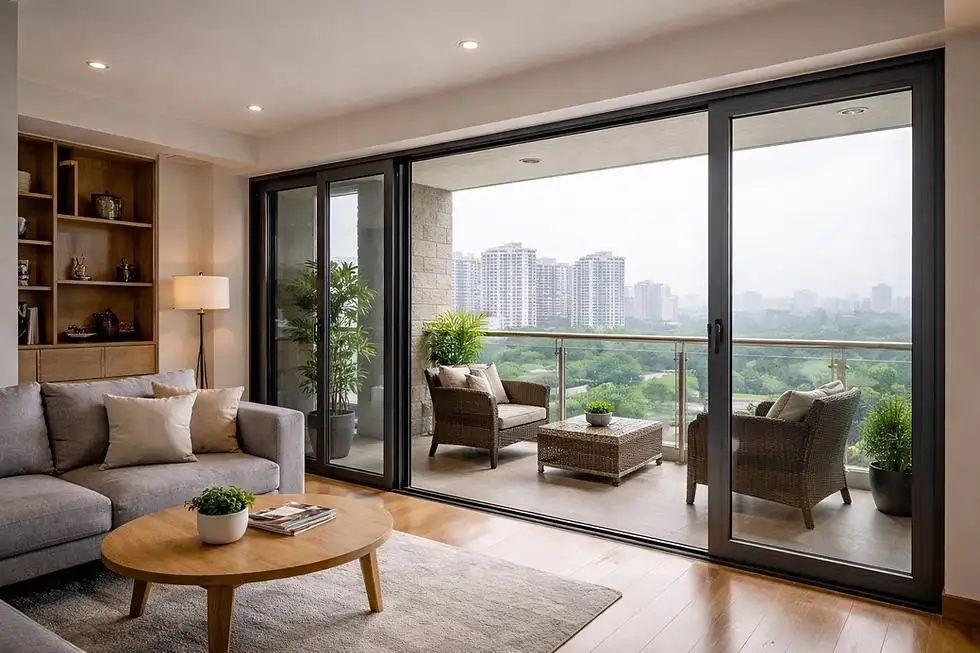
Architects think about its proportions. Homeowners think about the view. Interior designers think about daylight. Developers think about the facade.
But a high-performance window has another job: managing the transition between indoors and outdoors.
Think about what exists on the other side of the glass in a Delhi home. There may be traffic noise, road dust, outdoor heat, cold winter air and airborne pollutants.
The glass is only one part of the equation.
The frame, gaskets, hardware, joints and installation all influence how effectively the opening performs as part of the building envelope. Poorly sealed openings can allow unwanted air movement and make it harder to maintain a consistent indoor environment.
This is why choosing high-performance aluminium windows should not be reduced to selecting a frame colour or glass specification.
The question is bigger:
How well does the entire window system perform when the conditions outside become difficult?
The Small Details Matter
This is where window engineering becomes particularly important.
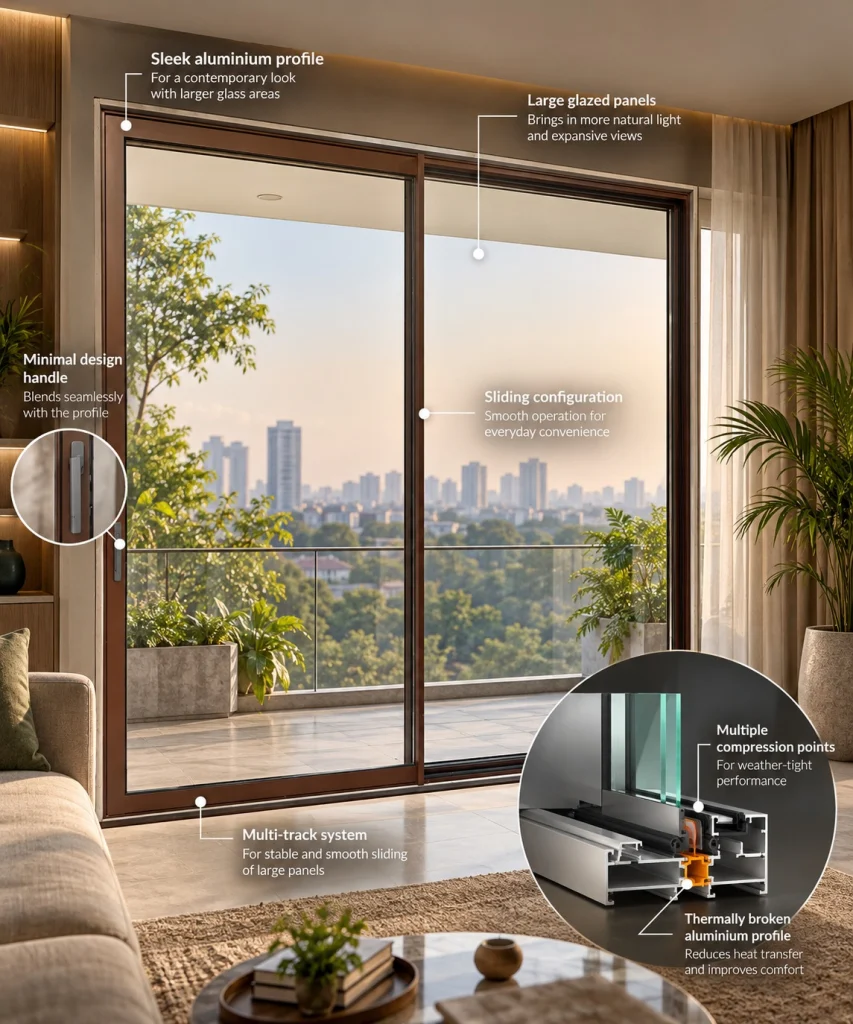
A well-designed window system relies on several components working together. Seals help reduce unwanted air and water infiltration. Hardware helps ensure that the sash closes properly. The frame provides structural stability. And the glass can be selected according to the project’s thermal, acoustic and solar-control requirements.
For example, Thermaline’s Seranova Sliding System is a thermally broken aluminium sliding system designed to support thermal comfort and reduce the intrusion of external noise. Its multiple compression points help improve sealing, contributing to a more comfortable indoor environment while maintaining smooth sliding operation.
The Signature system similarly incorporates three circumferential sealing along with multi-point locking, combining sealing performance with controlled closure of the window.
These details may not be immediately visible once a window is installed.
But they are precisely the details that can influence how the building feels every day.
Why Thermally Broken Aluminium Windows Matter
Thermal performance is another important part of the conversation.
Traditional aluminium is an excellent structural material, but aluminium also conducts heat efficiently. That can become a disadvantage when the temperature difference between indoors and outdoors is significant.
A thermal break changes the way the profile behaves.
Thermaline’s systems use polyamide strips between sections of the aluminium profile. These strips interrupt the direct conductive path through the metal and help reduce heat transfer through the frame.
In practical terms, this can contribute to a more stable indoor environment and reduce the amount of unwanted heat exchange through the window frame.
For Delhi and other parts of North India, where buildings may experience intense summer heat followed by cold winters, this becomes particularly relevant.
Thermal performance is therefore not just about saving energy. It is also about comfort.
So, Can Windows Keep Pollution Out?
This is where it is important to be precise.
Windows are not air purifiers.
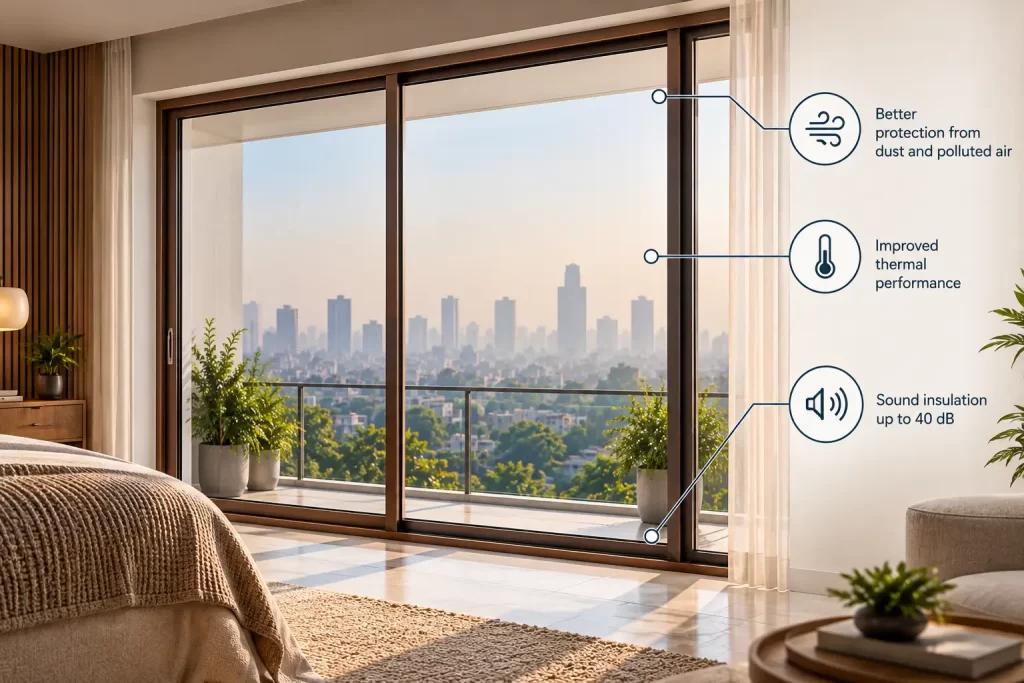
No window can guarantee that a building will be completely free from outdoor pollutants. Indoor air quality also depends on ventilation, filtration, doors, other openings, building pressure, installation quality and occupant behaviour.
What a well-designed and properly installed window system can do is reduce unwanted air infiltration and help create a more controlled indoor environment.
That distinction matters.
The objective isn’t to create an imaginary barrier between a home and the city. It is to make the building envelope perform better.
Looking at Windows as Part of the Building
For architects and designers, this is perhaps the most useful way to look at the subject.
A window should not be considered independently from the rest of the building.
The facade, glazing, frame, thermal break, seals, hardware and installation all work together.
A beautiful floor-to-ceiling opening is only truly successful when it also delivers the performance expected from the space behind it.
That is particularly relevant in Delhi-NCR, where architects increasingly work with large glazed openings while simultaneously dealing with heat, dust, noise and changing outdoor conditions.
This is where thermally broken aluminium windows can offer a useful combination of architectural flexibility and performance.
The Quiet Side of Luxury
Luxury architecture is often associated with visual elements: expansive glass, clean lines, large openings and carefully selected materials.
But there is another side to luxury that is experienced rather than seen.
It is the ability to sit inside your home without constantly noticing what is happening outside.
Less traffic noise.
Less dust entering through poorly sealed openings.
A more stable indoor temperature.
Better control over the environment.
And a window that allows you to enjoy the view without making you compromise on comfort.
That is increasingly becoming part of what modern luxury means.
Keeping the Outside, Outside

Delhi’s air-quality challenges remind us that the building envelope is not merely an architectural boundary. It is part of the building’s performance.
Windows sit right at that boundary.
The right combination of aluminium profiles, thermal breaks, glazing, seals, hardware and professional installation can help a building respond better to the conditions outside.
For homeowners and architects, therefore, the question should not simply be:
“How does this window look?”
It should also be:
“How does this window perform?”
Because when the city outside becomes harder to control, the building envelope becomes more important.
And sometimes, good architecture is not just about opening a space to the world.
It is knowing when—and how—to keep the outside, outside.
