



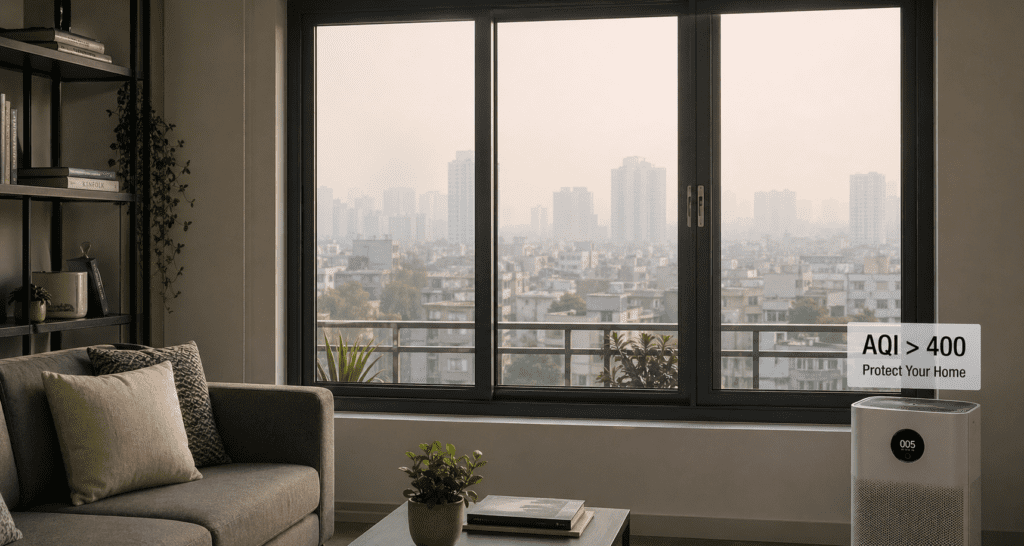
Every October, the same thing happens in Delhi. The air turns grey. Phone notifications start showing AQI numbers that shouldn’t exist — 350, 420, sometimes higher. Schools go online. Residents who can afford air purifiers turn them on and keep them running. And almost everyone seals their windows and sits inside, hoping the walls are doing their job.
But here’s the question most people never actually investigate: are your windows doing their job?
If you’re living in a Delhi or NCR apartment with standard aluminium windows — which is most of us — the answer is probably no. And the reason has everything to do with how those windows were built, how they’ve aged, and what thermal break windows do differently.
This isn’t a theoretical concern. It’s a measurable, physical problem with a documented solution. Let’s go through it properly.
How PM2.5 Actually Gets Into a Sealed Room
When Delhi’s AQI spikes, most people assume that closing the windows is enough. It isn’t — and the reason comes down to basic physics.
PM2.5 refers to particulate matter smaller than 2.5 microns in diameter. To give you a sense of scale: a human hair is approximately 70 microns wide. PM2.5 particles are nearly 30 times smaller than that. They don’t need a gap you can see. They move through micro-gaps in window seals, imperfect joints between the frame and the wall, and around deteriorated rubber gaskets — spaces that are invisible to the eye but enormous relative to the particle size.
Standard aluminium windows rely on brush seals or simple rubber compression seals between the frame and the glass, and between the frame and the wall. In a brand-new installation, these seals perform reasonably well. But aluminium is a highly conductive material, and in Delhi’s climate — which swings between -2°C in January and 45°C in June — the frame expands and contracts significantly with every seasonal cycle. Over 3 to 5 years, this repeated movement stresses the seals, degrades the rubber, and creates micro-gaps that no amount of cleaning will close.
Once those gaps exist, Delhi’s PM2.5 — along with PM10, vehicular exhaust particulates, and stubble-burning smoke during November — moves through them continuously, even with the window “shut.” Your air purifier is working overtime not because the pollution is making its way through glass, but because it’s making its way through the frame.
What Thermal Break Windows Do Differently
Thermal break windows reduce particle infiltration not by filtering air, but by maintaining seal integrity far better than standard aluminium windows over time.
This is an important distinction. A thermal break window is not an air filter. It does not block particles the way a HEPA filter does. What it does is structurally resist the seal degradation that creates the infiltration pathways in the first place.
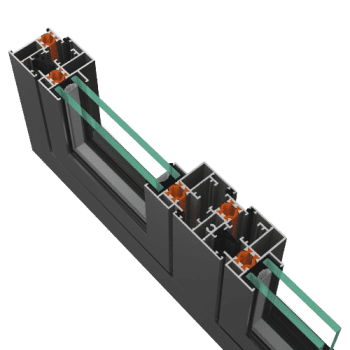
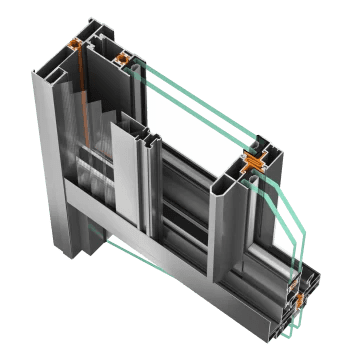
Here’s the mechanism: a thermally broken aluminium frame is split into two separate sections — one exterior, one interior — connected by a reinforced polyamide strip that conducts neither heat nor cold effectively. Because the inner and outer sections of the frame are thermally isolated from each other, neither section experiences the full temperature differential between inside and outside.
In practice, this means the inner frame section — the part your seals and gaskets are attached to — stays much closer to your room temperature year-round. It expands and contracts far less than a standard aluminium frame would. Over a decade of Delhi summers and winters, the cumulative stress on the seals is dramatically lower. The seals stay effective. The micro-gaps that would otherwise form in standard frames take years longer to develop.
The result: in a properly installed thermal break window with quality compression seals and a sealed perimeter joint between the frame and the wall, PM2.5 infiltration is significantly reduced compared to an equivalent standard aluminium installation — not because the window is filtering, but because it’s not leaking.
The Installation Matters as Much as the Product
This is the part most window guides leave out, and it’s critical for anyone making a decision specifically to improve indoor air quality.
Even the best thermal break window, installed with a poor perimeter seal between the frame and the wall, will allow particle infiltration through the frame-wall joint. This joint — the gap between the outside of the window frame and the inner wall surface — is where standard installation practices most often fail.
In budget installations, this joint is filled with basic mortar or left with visible gaps covered by an interior bead. In a properly executed installation, the joint is sealed with a combination of PU foam, vapour-permeable membrane tape on the exterior (which allows moisture to escape while blocking particulate ingress), and a quality interior sealant. This three-layer perimeter seal system is what actually prevents pollution from travelling in through the wall-frame boundary rather than through the glass or frame itself.
When you are evaluating window suppliers with the specific goal of reducing PM2.5 infiltration, ask explicitly about their perimeter sealing specification. If they cannot describe the system in detail, the product alone — however premium — will not deliver the air quality improvement you’re looking for.
What the Research Says: Indoor Air Quality and Window Sealing
Studies on indoor air quality in Delhi NCR residential buildings have consistently found that infiltration through building envelope gaps — including window frame joints and deteriorated seals — is one of the primary routes for outdoor PM2.5 to enter sealed apartments. Research published in academic journals focused on Indian building environments found that indoor PM2.5 concentrations in apartments with well-sealed windows and positive pressure ventilation were 40–60% lower than in equivalent apartments with standard window installations.
This finding aligns with the principle that reducing the air change rate through unintentional gaps (rather than through ventilated air which passes through HEPA filtration) is the most direct lever for improving indoor PM2.5 levels in Delhi homes.
For practical purposes: a thermal break window system with proper perimeter sealing works alongside your air purifier, not instead of it. The purifier handles the air that is intentionally exchanged (when you open doors, use ventilation, or open windows briefly). The window sealing system reduces the constant background infiltration that forces your purifier to run at maximum capacity around the clock during high-AQI days.
A Practical Priority List for Delhi Residents Concerned About AQI
If indoor air quality during Delhi’s winter AQI season is your primary motivation for evaluating windows, here’s an honest priority order:
Priority 1 — Check your existing seals first. Before replacing windows entirely, have a professional inspect the perimeter joints and frame seals. If the building is less than 5 years old and the seals are intact, targeted re-sealing may close the main infiltration pathways at lower cost.
Priority 2 — If windows are 8+ years old, seal degradation is likely irreversible. Standard aluminium windows in Delhi NCR apartments that are a decade old have typically experienced enough thermal cycling to compromise seals meaningfully. Replacement is more effective than repeated re-sealing at this stage.
Priority 3 — When replacing, specify the full system: frame + glass + perimeter seal. The frame profile (thermal break vs. standard), the glass specification (double-glazed units dramatically reduce infiltration pathways vs. single-pane), and the perimeter installation method are all part of the same system. Optimising one while ignoring the others limits your result.
Priority 4 — Don’t rely on windows alone. In a city where AQI can reach 400+, windows reduce baseline infiltration. A HEPA air purifier handles the residual. Positive pressure ventilation systems (HRVs with HEPA filtration) are the next step for those with serious health concerns. These systems work best in an apartment with low-infiltration windows, because they lose effectiveness when they’re constantly fighting infiltration through gaps.
The Thermaline® Approach for Delhi NCR Homes
Thermaline® has been engineering thermally broken aluminium window systems in India for over 20 years — through the full range of Delhi’s climate extremes. Our EcoSlide® and EcoCasement® systems are specified with multi-point compression seals, and our installation teams are trained on perimeter sealing methods appropriate for Delhi’s high-pollution, extreme-temperature environment.
We don’t position thermal break windows as an air purifier. They are not that. What we offer is a window system that maintains its structural integrity and seal effectiveness over the long-term in Delhi’s climate — which is the foundation of any meaningful improvement in indoor particle infiltration.
If you’re evaluating windows specifically in the context of Delhi’s air quality, we’re happy to walk through the specific infiltration risks in your apartment and what a properly specified installation would address.
FAQs
Why do standard aluminium windows fail to prevent PM2.5 infiltration during high pollution days in Delhi?
Standard aluminium windows rely on simple seals that degrade over time due to temperature-induced expansion and contraction, creating micro-gaps through which tiny PM2.5 particles can enter even when the windows are closed.
How do thermal break windows reduce the infiltration of PM2.5 particles?
Thermal break windows maintain better seal integrity over time by using a thermally isolated frame structure, which minimizes seal degradation and micro-gap formation, thereby significantly reducing PM2.5 infiltration.
Why is the installation process as important as the choice of window product?
Proper installation ensures that the perimeter joint between the window frame and the wall is well sealed with materials like PU foam, vapor-permeable membranes, and quality sealants, preventing infiltration that can undermine the window’s performance.
Can choosing the right windows completely eliminate PM2.5 exposure indoors?
No, even the best-sealed thermal break windows are part of a broader strategy; using air purifiers and ventilation systems alongside good window sealing provides the most effective indoor air quality control.
What steps should Delhi residents take to improve indoor air quality related to window sealing?
Residents should first inspect and seal existing window perimeter joints, consider replacing old windows with thermal break systems with proper sealing, and supplement with air purifiers or positive pressure ventilation systems for best results.
