


Let’s talk about one of the biggest and most permanent decisions you’ll make for your home: your windows.
It’s easy to get lost in the aesthetics—the sleek lines, the powder-coated colours, the promise of a big, beautiful view. But here’s the hard truth, especially in a country as diverse as India: not all aluminium windows are created equal.
Choosing a window system that looks great in a catalogue but isn’t engineered for your specific climate is a costly mistake.
A window in a sea-facing Mumbai apartment has a completely different job than one in a frosty Shimla home. A window in Delhi has to fight off 45°C heat, while one in Bengaluru needs to handle sudden rain.
If you get it wrong, you’re signing up for years of high electricity bills, uncomfortable rooms, and potential issues like condensation or rattling.
So, how do you get it right? You stop thinking about it as just “buying a window” and start thinking about it as “investing in a climate-control system.”
The Big Myth: “All Aluminium is the Same”
Let’s get one thing straight. Aluminium is a fantastic material—it’s strong, durable, low-maintenance, and allows for those beautiful, slim frames.
But it has one major, natural characteristic: it’s a fantastic conductor of heat.
Think about it. A single, solid piece of aluminium is like a metal pipe. In the summer, it becomes a thermal super-highway, pulling the scorching heat from outside and transferring it directly into your living room. Your air conditioner never gets a break.
In a cold climate, it does the exact opposite, sucking the precious warmth from your heater and leaking it outside.
This is why a basic, “non-thermal” aluminium window (the kind you’ll find in many standard developments) is often a poor choice for comfort and energy efficiency.
The Most Important Term You Need to Know: Thermal Break
This is where the engineering gets smart. This is the single biggest difference between a “cheap” aluminium window and a high-performance one.
So, what is a Thermal Break?
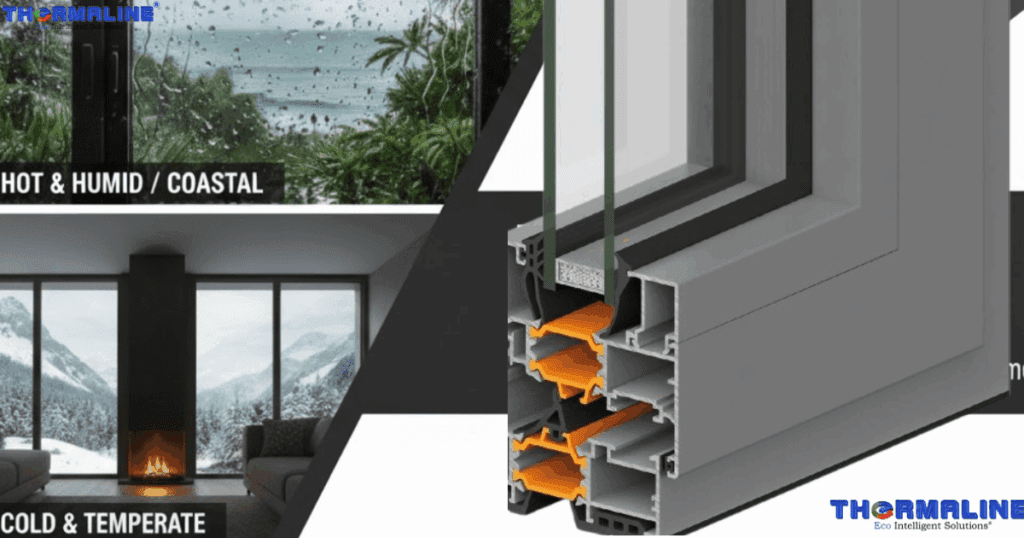
Imagine you have two separate aluminium frames—one for the inside of your house and one for the outside. In between them, a high-tech, super-strong insulator (a polyamide strip) is inserted to join them.
This insulator stops the heat (or cold) in its tracks. It creates a “break” in the thermal highway.
The heat from the outside frame cannot transfer to the inside frame.
At Thermaline, this is the core of our philosophy. Our name is built on this science. A window without a thermal break is just a well-framed hole in your wall. A thermally broken aluminium window is a high-performance insulating shield.
Why is this non-negotiable?
- Massive Energy Savings: Your AC or heater works dramatically less. This isn’t a small saving; it’s a significant, permanent reduction in your monthly electricity bills.
- Total Comfort: Your room stays at a stable, comfortable temperature. No more “hot spots” near the glass.
- No Condensation: In cold or humid climates, thermal breaks prevent that “sweat” on the inside of your frames, which can damage walls and promote mould.
Decoding India’s Climates: A Window for Every Zone
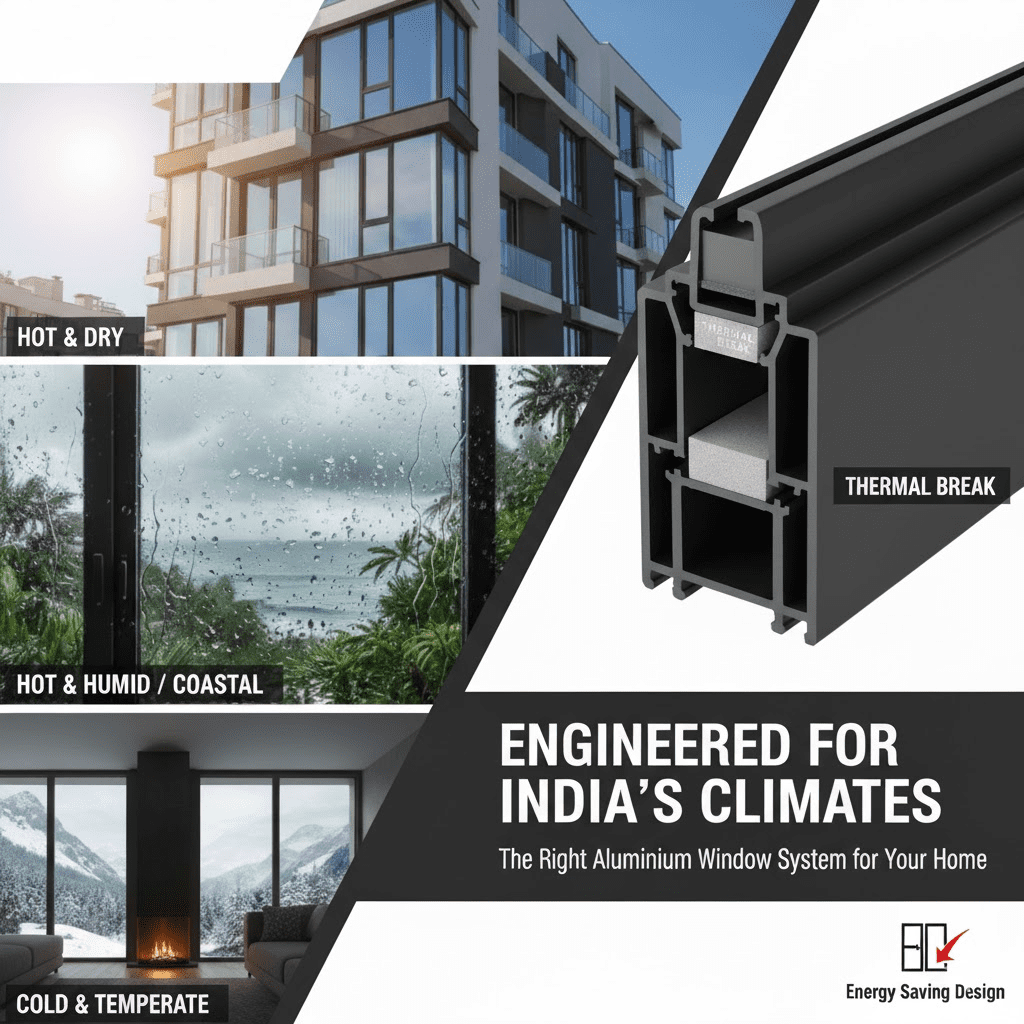
India doesn’t have one climate; it has many. Let’s break down what you need for your specific location.
Zone 1: Hot & Dry (e.g., Delhi, Jaipur, Nagpur, Hyderabad)
- Your Main Battle: Extreme summer heat (often 40-45°C+) and surprisingly cold winters.
- Your Non-Negotiable: A Thermal Break system. This is your #1 priority. It will work overtime in both summer and winter.
- Your Glass: You must pair this with Double Glazed Units (DGU). Specifically, look for a solar-control Low-E coating. This special coating is a microscopic shield that reflects the sun’s heat radiation out of your home, while still letting in visible light.
- Zone 2: Hot & Humid / Coastal (e.g., Mumbai, Chennai, Kolkata, Goa)
- Your Main Battle: Constant heat, intense humidity, and corrosive salt in the air.
- Your Non-Negotiables:
- Thermal Break: Crucial for keeping your AC’s cool air in and the sticky, hot air out.
- Corrosion-Resistant Finish: This is key. The aluminium needs a high-grade, marine-quality powder coating or anodized finish to resist pitting and fading from the salt.
- Superior Water-Proofing: Your window system must have excellent gaskets and built-in drainage channels to handle the force of monsoon rains without a single leak.
Zone 3: Cold & Temperate (e.g., Bengaluru, Pune, Shimla, Himalayas)
- Your Main Battle: Keeping your home warm and preventing heat loss.
- Your Non-Negotiables:
- Thermal Break: Again, this is essential, but for the opposite reason. It stops your expensive indoor heat from escaping through the frame.
- Double or Triple Glazing: A standard DGU is a must. For extreme cold (like in the Himalayas), Triple Glazing is the gold standard.
- Airtightness: You need a system with high-quality, multi-compression gaskets. This creates a perfect seal to stop cold drafts and whistles, making your home truly cozy.
Beyond Climate: 3 Other Factors You Can’t Ignore
Once you’ve zeroed in on the right thermal system, consider these:
- Sound Insulation: If you live on a busy urban road, the value of silence is priceless. A high-performance thermal break system, combined with a DGU (especially one with laminated glass), can cut down outside noise by over 70%.
- Wind Load: Are you in a high-rise apartment or on the coast? Your windows will face immense wind pressure. You need a “heavy-duty” system with reinforced profiles that has been tested to withstand high wind loads without rattling or flexing.
- Security: Your window is a potential entry point. Look for systems that offer multi-point locking mechanisms, steel-reinforced frames, and toughened or laminated (shatter-proof) glass.
Our Final Word: Choose a System, Not Just a Window
Your home is your biggest investment. Your windows are a critical part of that investment’s long-term performance.
Don’t just ask, “How much does it cost?” Ask, “How is it engineered?” Ask, “Does it have a thermal break?” Ask, “What glass is specified?” Ask, “How will this perform in my city?”
At Thermaline, our name says it all. We don’t just sell aluminium; we engineer thermal comfort. We believe the right window system isn’t an expense—it’s an investment that pays you back every single day, in comfort, in silence, and in lower energy bills.
Don’t settle for a one-size-fits-all solution. Choose an engineered system that’s built for your climate.
Confused about what your home really needs? Talk to a Thermaline expert today. We’ll help you analyze your climate and design a window system that’s perfect for you.
FAQs
Why is it important to consider climate when choosing aluminium windows?
Considering climate is vital when selecting aluminium windows because different environments in India, such as coastal, hot, dry, or cold regions, require specific features like thermal breaks, weather-resistant finishes, or enhanced glazing to ensure energy efficiency, comfort, and durability.
What is a thermal break and why is it essential for aluminium windows?
A thermal break is an insulator inserted between the inside and outside aluminium frames, preventing the transfer of heat or cold through the window. It is essential because it significantly improves energy efficiency and maintains a stable indoor temperature.
How does a thermal break improve energy savings and comfort?
A thermal break reduces heat transfer, leading to lower cooling and heating costs, and ensures indoor spaces remain comfortable by preventing hot spots, condensation, and temperature fluctuations.
What specific window features should I consider for coastal or humid regions in India?
For coastal or humid regions, windows should include a high-grade, marine-quality corrosion-resistant finish, a thermal break to control humidity-induced temperature fluctuations, and superior waterproofing with effective gaskets and drainage channels.
How do I identify a window system engineered for my specific climate?
A climate-specific window system should feature a thermal break for insulation, appropriate glazing options such as double or triple glazed units with reflective coatings, high-quality weatherproof finishes, and specifications tailored to resist environmental factors like salt, moisture, or extreme temperatures.
