


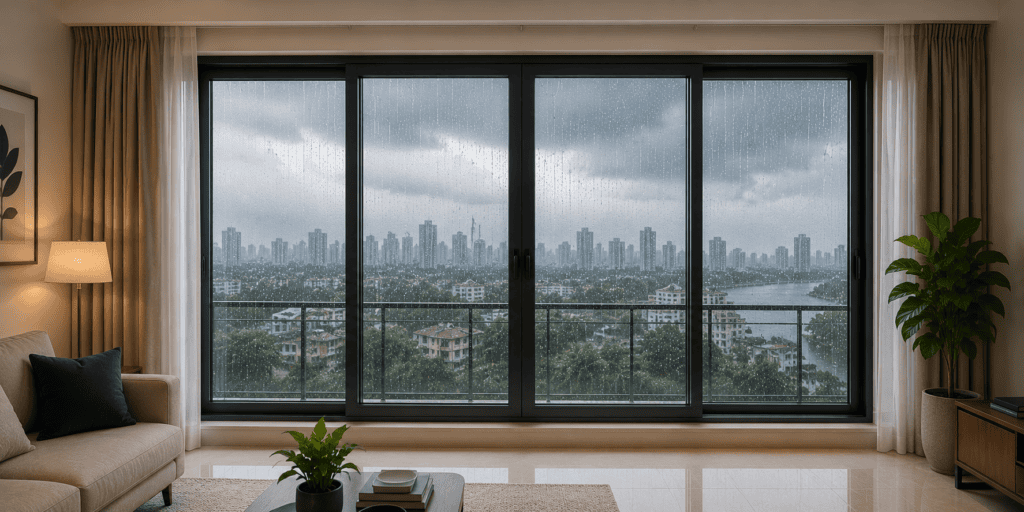
Mumbai’s 2026 southwest monsoon arrived nearly two weeks late, and then made up for lost time immediately. The system reached the city on June 13 and, rather than the gradual onset residents are used to, delivered over 200mm of rainfall across multiple zones within hours — one of the most disruptive early-season monsoon events in recent memory. Suburban trains halted. Streets submerged. And across thousands of apartments, residents discovered — often the hard way — exactly which parts of their windows weren’t ready.
Mumbai’s relationship with monsoon flooding is not new. The city’s original stormwater drainage network, designed in the early 20th century, was built to handle only about 25mm of rainfall per hour — a fraction of what modern monsoon downpours regularly deliver. The catastrophic July 26, 2005 deluge, when 944mm fell in 24 hours and the city came to a standstill for nearly a week, remains the benchmark event. But the pattern since then — repeated serious disruptions in 2017, 2019, 2021, 2023, 2025, and now 2026 — shows this isn’t an anomaly. It’s Mumbai’s monsoon, every year, with increasing intensity.
Your windows are the first line of defence between this reality and your home’s interior. Before the next major spell hits — and in Mumbai, there will be a next one, usually arriving in July with 800-900mm of rainfall across the month — here is the 7-point checklist Thermaline® runs on every Mumbai site assessment.
1. Check the Compression Seal — Not Just Whether There’s a Seal
What to verify: Run your finger along the seal where the window panel meets the frame. A compression seal feels firm and continuous, springing back when pressed. A brush seal feels like dense bristles — it blocks some airflow but doesn’t create the same sealed pressure contact.
Why it matters: Compression seals maintain consistent contact pressure under wind-driven rain. Brush seals — common in budget sliding windows across Mumbai’s high-rise stock — perform reasonably in calm conditions but lose effectiveness exactly when Mumbai’s monsoon wind picks up, which is precisely when you need the seal most.
What failure looks like: Water tracking along the bottom of the window frame during heavy rain, even when the window is fully closed.
2. Inspect the Bottom Track Drainage Ports
What to verify: Locate the small drainage holes or slots along the bottom track of your sliding window (usually 2-4 ports per panel width). Check they’re not blocked by dust, debris, or old sealant.
Why it matters: During Mumbai’s high-intensity rain events — the kind that delivered over 200mm in hours during the 2026 onset — the bottom track needs to evacuate water faster than it’s arriving. Blocked or undersized drainage ports cause water to back up and overflow into the room, even when the seal itself is intact.
What failure looks like: Pooling water visible in the bottom track after rain, or water entering the room specifically at the bottom of the window even though the rest of the frame stays dry.
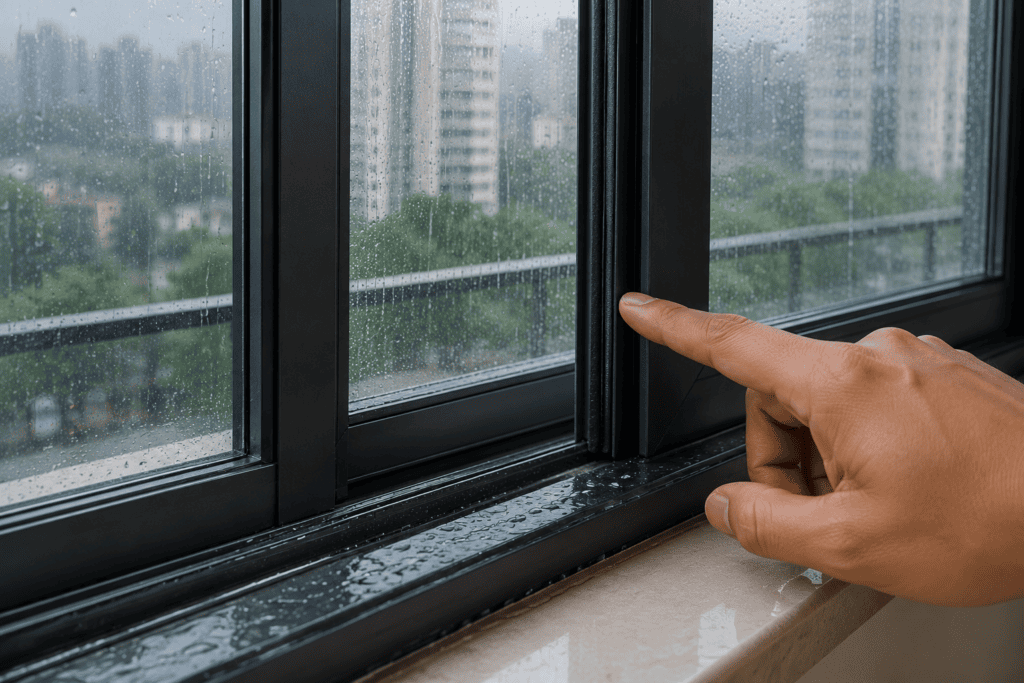
3. Examine the Frame-Wall Joint From Both Inside and Outside
What to verify: Look at the gap between your window frame and the surrounding wall — both from inside the room and, if accessible, from outside the building. Check for visible cracks, gaps, or discoloured/peeling sealant.
Why it matters: This joint, not the window itself, is the single most common source of water infiltration in Mumbai apartments. The correct specification is a three-layer system: PU foam backing, vapour-permeable membrane tape on the exterior, and a quality sealant bead on the interior. A single bead of silicone applied during standard installation — common practice across much of Mumbai’s mid-market construction — typically shows adhesion failure within 4-6 years in Mumbai’s humid, monsoon-saturated climate.
What failure looks like: Damp patches or visible water staining on the interior wall immediately around the window frame, particularly after sustained rain.
4. Confirm Your Frame’s Wind Load Rating Matches Your Floor Level
What to verify: Ask your original installer or supplier for the documented wind load rating (typically in kPa) of your window system, and compare it against your building’s floor level and exposure.
Why it matters: For apartments above the 15th floor, or units with direct exposure to Mumbai’s coastal wind without windbreaks, wind pressure during monsoon storms is substantially higher than what standard residential-grade frames are designed for. An undersized frame profile flexes under this pressure — even minimally and invisibly — and that flex breaks seal contact at the exact moment wind-driven rain is at its most intense.
What failure looks like: Water infiltration that seems to correlate specifically with wind direction and intensity, rather than rainfall volume alone — a pattern many high-rise residents notice but don’t connect to frame rigidity.
5. Test Whether the Window Closes Fully and Locks Without Force
What to verify: Close and lock every window in your home. It should close smoothly and lock without requiring extra force or repeated attempts.
Why it matters: Aluminium frames expand and contract with Mumbai’s seasonal temperature shifts, and standard frames experience more of this movement than thermally broken ones. Over years, this cycling can cause frames to warp slightly out of true alignment — a window that needs force to close is a window that isn’t sealing correctly even when it appears shut.
What failure looks like: A window that “looks closed” but still allows a draft or fine spray to enter during wind-driven rain — because the panel isn’t actually seated correctly against the seal.
6. Check Hardware for Corrosion — Especially in Coastal-Facing Units
What to verify: Inspect hinges, handles, and locking mechanisms for rust, stiffness, or visible pitting — particularly in apartments along Worli, Bandra West, Marine Drive, or anywhere within a few kilometres of the coast.
Why it matters: Mumbai’s combination of monsoon humidity and coastal salt air accelerates corrosion in standard zinc-alloy hardware. Corroded hardware prevents windows from closing flush, which compromises the seal even if the seal itself is in good condition.
What failure looks like: Handles that feel stiff or grinding, locks that don’t engage fully, or visible orange-brown corrosion on metal components.
7. Look for Condensation or Mould at the Frame Edges
What to verify: Check the inside edges of your window frames, particularly in bathrooms and bedrooms, for persistent condensation, discolouration, or visible mould growth.
Why it matters: Standard aluminium frames conduct temperature differentials directly, creating cold surfaces where indoor humidity condenses. Combined with Mumbai’s already high ambient humidity during monsoon, this creates ideal conditions for mould growth at window frame junctions — a health concern as much as a structural one.
What failure looks like: Black or green discolouration at frame corners, a persistent musty smell near windows, or visible water droplets on the frame’s interior surface on humid mornings.
What to Do If Your Windows Fail This Checklist
If you’ve identified one or two issues — a slightly stiff handle, minor drainage port blockage — targeted maintenance before the next major spell can meaningfully improve performance. Clean drainage ports, lubricate hardware, and have a professional re-seal the frame-wall joint if it shows early signs of cracking.
If you’re seeing three or more issues, or if you’ve already experienced water infiltration during a previous monsoon, the underlying window system has likely crossed from “needs maintenance” to “needs replacement.” Continuing to patch a failing system year after year typically costs more over a 5-year period than a proper replacement — and the cumulative water damage to walls and flooring from repeated minor infiltration adds a cost most residents don’t track until it becomes a larger repair.
Why Thermaline® Specifies Differently for Mumbai
Mumbai’s market includes AluPure — recently rebranded to Koemmerling Aluminium Systems as of December 2025, announced at the ZAK Expo in Mumbai itself, as part of profine Group’s broader repositioning — and Prominance, with strong uPVC dealer presence across the city via platforms like Justdial.
What’s notable about the broader market: most published content from these brands addresses monsoon performance in general terms — “weather resistant,” “durable” — without disclosing the specific compression seal type, drainage port sizing, or three-layer perimeter sealing methodology that this checklist covers. For Mumbai’s monsoon intensity, generic durability claims aren’t sufficient information to make a purchase decision.
Thermaline®’s EcoSlide® and EcoCasement® systems are specified and documented against every item on this checklist — multi-point compression seals, drainage channels sized for high-intensity rainfall, three-layer perimeter sealing as standard installation practice, wind load ratings matched to Mumbai’s high-rise exposure conditions, and marine-grade hardware for coastal-facing properties. Our 20+ years of Indian climate engineering means we built this checklist from real Mumbai monsoon failures, not from a product catalogue.
If your windows failed three or more items on this checklist, get a free assessment from Thermaline® before the next major spell arrives.
FAQs
What is Thermaline®’s 7-point checklist for Mumbai monsoon window performance?
Thermaline®’s 7-point checklist guides site assessments to ensure windows withstand Mumbai’s monsoon. It covers verifying compression seals, inspecting bottom track drainage ports, examining the frame-wall joint from inside and outside, confirming wind load ratings match floor level, testing full closure and locking without force, checking corrosion-prone hardware, and looking for condensation or mould at the frame edges.
How can I tell if my window seal is a compression seal or a brush seal and why does it matter?
Run your finger along the seal where the window panel meets the frame. A compression seal feels firm and continuous and springs back when pressed, while a brush seal feels like dense bristles. Compression seals maintain consistent contact pressure under wind-driven rain, whereas brush seals can lose effectiveness when monsoon winds pick up.
What should I check in the bottom track drainage ports and what does failure look like?
Locate the small drainage holes along the bottom track (usually 2–4 ports per panel width) and ensure they are not blocked by dust, debris, or old sealant. Blocked drainage ports cause water to back up and overflow into the room, even if the seal is intact.
Why is the frame-wall joint important and what is the correct three-layer sealing system?
The frame-wall joint is the main source of water infiltration in Mumbai apartments. The correct three-layer system is a PU foam backing, vapour-permeable exterior tape, and a quality interior sealant bead. A single silicone bead, common in mid-market construction, often fails adhesion within 4–6 years in Mumbai’s humid climate.
When should I consider replacing windows rather than just maintenance?
If you identify three or more issues, or if you’ve already experienced water infiltration during a monsoon, the window system has likely crossed from maintenance to replacement. Replacing the system can be more cost-effective over five years than ongoing patching and can prevent further damage to walls and flooring.
