


Green building certification is no longer an optional premium for Gujarat’s commercial and institutional projects. Government buildings, large residential complexes, IT parks, and a growing number of premium residential developments are pursuing GRIHA (Green Rating for Integrated Habitat Assessment) certification — India’s national green building standard, developed by TERI and adopted by the Government of India in 2007.
For architects, developers, and building owners in Gujarat, windows are one of the most directly scored elements in the GRIHA framework. The Solar Heat Gain Coefficient (SHGC), U-value, and Visible Light Transmittance (VLT) of your fenestration are not soft sustainability claims — they are quantified criteria that your project must meet to pass the mandatory compliance review.This guide answers the practical question: which window systems actually qualify for GRIHA compliance in Gujarat, and what specification numbers do you need?
How GRIHA Scores Windows: The Technical Framework
GRIHA uses the Energy Conservation Building Code (ECBC 2007 and updated standards) as its benchmarks for fenestration performance. Windows must meet prescribed SHGC maximums based on climate zone and facade orientation to pass the mandatory criteria.
India is divided into five climate zones under ECBC. Ahmedabad falls in Climate Zone 1: Hot and Dry — one of the most thermally demanding classifications in the code, which means the SHGC requirements for Gujarat buildings are among the most stringent in the country.
Under GRIHA V2015 Criteria 11.1.2 (Energy Performance), all fenestration must either:
- Meet the prescribed maximum SHGC values per orientation as specified in ECBC Table 4.4 for the project’s climate zone, OR
- Achieve a weighted façade average SHGC (calculated across each orientation) that meets the ECBC threshold
For Ahmedabad (Hot and Dry climate zone), the SHGC requirements under ECBC are:
- West-facing glazing: Maximum SHGC of approximately 0.25–0.27 (the tightest restriction, reflecting Ahmedabad’s intense afternoon solar exposure)
- South-facing glazing: Maximum SHGC of approximately 0.25–0.30
- East-facing glazing: Maximum SHGC of approximately 0.30–0.35
- North-facing glazing: SHGC requirements are less restrictive as no direct solar radiation falls on north-facing facades in the northern hemisphere
Additionally, the U-value of the overall window unit (frame + glass combined) should target below 1.5 W/m²K for high-performance compliance, with the frame U-value as a separate scored element.
The Projection Factor (PF) — the ratio of shading device depth to window height — is used with an M-factor from ECBC Table 4.4 to calculate the effective SHGC (SHGCeff). A window with adequate external shading can have a higher nominal SHGC because the M-factor reduces the effective solar gain. For unshaded façades — the most common situation in modern Ahmedabad apartment towers — the glass SHGC must meet the code threshold directly.
Which Window Systems Actually Meet the GRIHA Brief in Gujarat?
Standard aluminium windows with clear glass do not meet GRIHA/ECBC SHGC requirements for most orientations in Gujarat.
Standard clear double glazing has an SHGC of approximately 0.65–0.70. For west-facing windows in Ahmedabad, the ECBC maximum is around 0.25–0.27. Standard clear glass fails this threshold by a factor of nearly three. No amount of frame specification upgrades the glass — the SHGC is a property of the glazing unit itself.
The specification that meets GRIHA compliance for hot and dry Gujarat:
Glass: Low-E coated double-glazed unit with soft-coat (sputtered) Low-E on surface 3 of the IGU. This specification delivers:
- SHGC: 0.23–0.28 (meets west-facing Gujarat threshold)
- Visible Light Transmittance (VLT): 55–65% (satisfies daylighting criteria, which GRIHA also scores)
- U-value of glazing unit: 1.1–1.4 W/m²K
The combination of meeting both the SHGC threshold AND maintaining acceptable VLT is what makes Low-E the specification that satisfies GRIHA’s dual requirement — reducing heat gain without over-tinting the glass to the point of failing daylighting criteria.
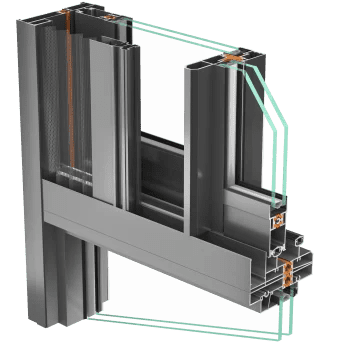
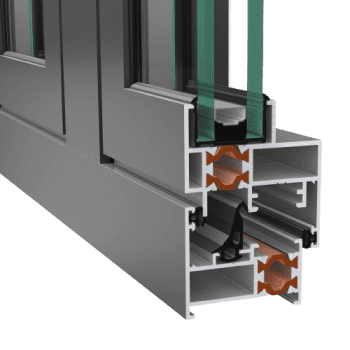
Frame: Thermally broken aluminium. For overall window U-value to meet the 1.5 W/m²K target, the frame must be thermally broken. Standard aluminium frames have U-values in the range of 5.0–6.0 W/m²K — when area-averaged with the glass unit, they pull the overall window U-value above the compliance threshold. A thermal break frame with U-value of 1.6–2.2 W/m²K, area-averaged with the qualifying glazing unit, achieves the overall window U-value needed for GRIHA documentation.
Competitor Check: What AluPure and ALCOI Offer for GRIHA Projects
For Gujarat-based architects and developers sourcing windows for GRIHA projects, the supplier landscape matters.
AluPure, with manufacturing in Vadodara, offers aluminium window systems in Gujarat. Their product documentation references “built for extreme weather conditions” and performance testing at third-party laboratories. However, their thermal break minimal system is still being introduced — meaning GRIHA-compliant projects needing thermal break frames today may find AluPure’s compliance-ready thermal break product still in the introduction phase rather than fully available.
ALCOI’s presence in Gujarat is limited. Their market concentration is in North India (Delhi NCR, Punjab), and city-specific service and installation capability for Ahmedabad GRIHA projects is not documented in their publicly available materials.
Prominance offers uPVC windows in Ahmedabad — but uPVC’s dimensional instability in Gujarat’s extreme thermal range and its limited suitability for large-format commercial openings makes it a less common specification for GRIHA commercial and institutional projects, which typically require structural aluminium systems.
Thermaline®’s EcoSlide® and EcoCasement® systems are available with thermal break frames and GRIHA-compliant Low-E glass specifications today — with glass performance data sheets in the format required for GRIHA/ECBC documentation submission. Our team has experience preparing the fenestration documentation for green building certification submissions, including SHGC calculations using ECBC M-factor methodology for shaded and unshaded facades.
The GRIHA Documentation Process for Windows: What You Need
For architects and project managers preparing GRIHA submissions in Gujarat, the fenestration documentation package should include:
1. Glass performance certificates. The Low-E glass specification must be supported by certified performance data from the glass manufacturer — SHGC, U-value, and VLT values tested to EN 673 or NFRC standards. Thermaline® provides these data sheets for all glass specifications we supply.
2. Frame U-value calculations. The overall window U-value must be calculated using the centre-of-glass U-value, edge-of-glass U-value, and frame U-value in the ISO 10077 methodology. Thermal break frame U-values are significantly lower than standard aluminium, enabling the overall window to meet the GRIHA threshold.
3. SHGC compliance calculation per orientation. Using the ECBC Table 4.4 M-factor approach, each facade’s weighted average SHGCeff must be calculated and demonstrated to be within the prescribed maximum. Unshaded facades in Ahmedabad require glass SHGC below the threshold without M-factor adjustment.
4. Installation specification for air infiltration. GRIHA also scores air infiltration through the building envelope. The window perimeter seal specification — three-layer: PU foam, membrane tape, sealant — contributes to the air infiltration compliance documentation.
Why Getting the Window Specification Right at Design Stage Saves Money
GRIHA’s mandatory criteria must be met before the project is rated. If the window specification fails the mandatory SHGC review at the documentation stage, the project is flagged for non-compliance — and remediation means either replacing the glass with a compliant Low-E specification or adding external shading devices to reduce the effective SHGC. Both are expensive post-design corrections.
Specifying compliant thermal break windows with Low-E glazing at the design stage costs no more in specification effort than specifying standard windows. The product cost premium is real, but it is priced into the project budget — not encountered as an unexpected remediation cost after the design is complete.
Thermaline® works with architects and developers at the early specification stage to confirm compliance before documentation is submitted. This upstream involvement eliminates the compliance risk and ensures the fenestration specification contributes to — rather than risks — the project’s GRIHA rating.
If you are working on a GRIHA-rated project in Gujarat and need fenestration compliance documentation support, speak to the Thermaline® team before specification is finalised.
