
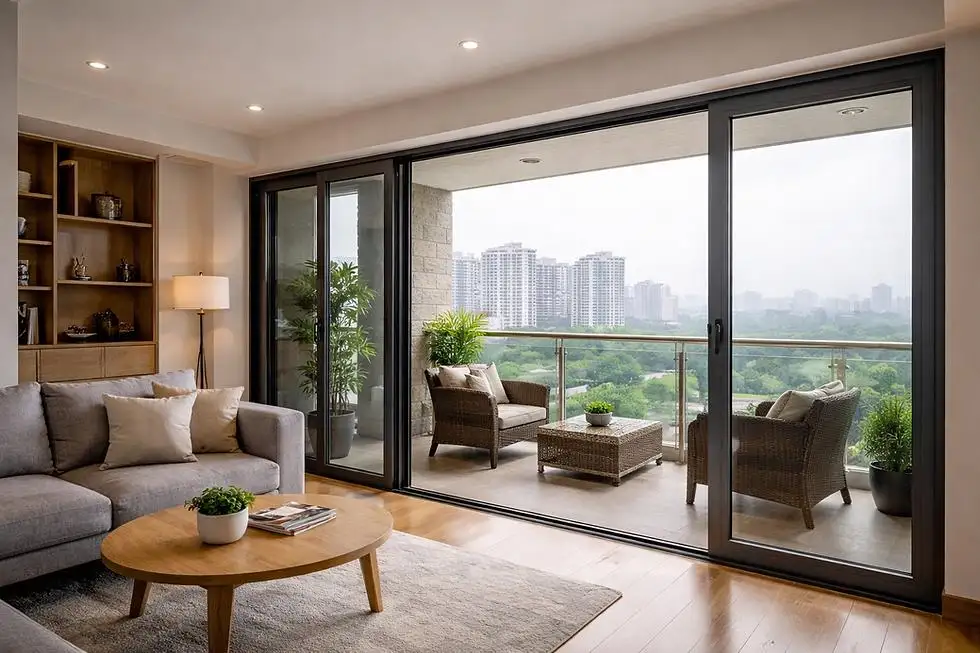
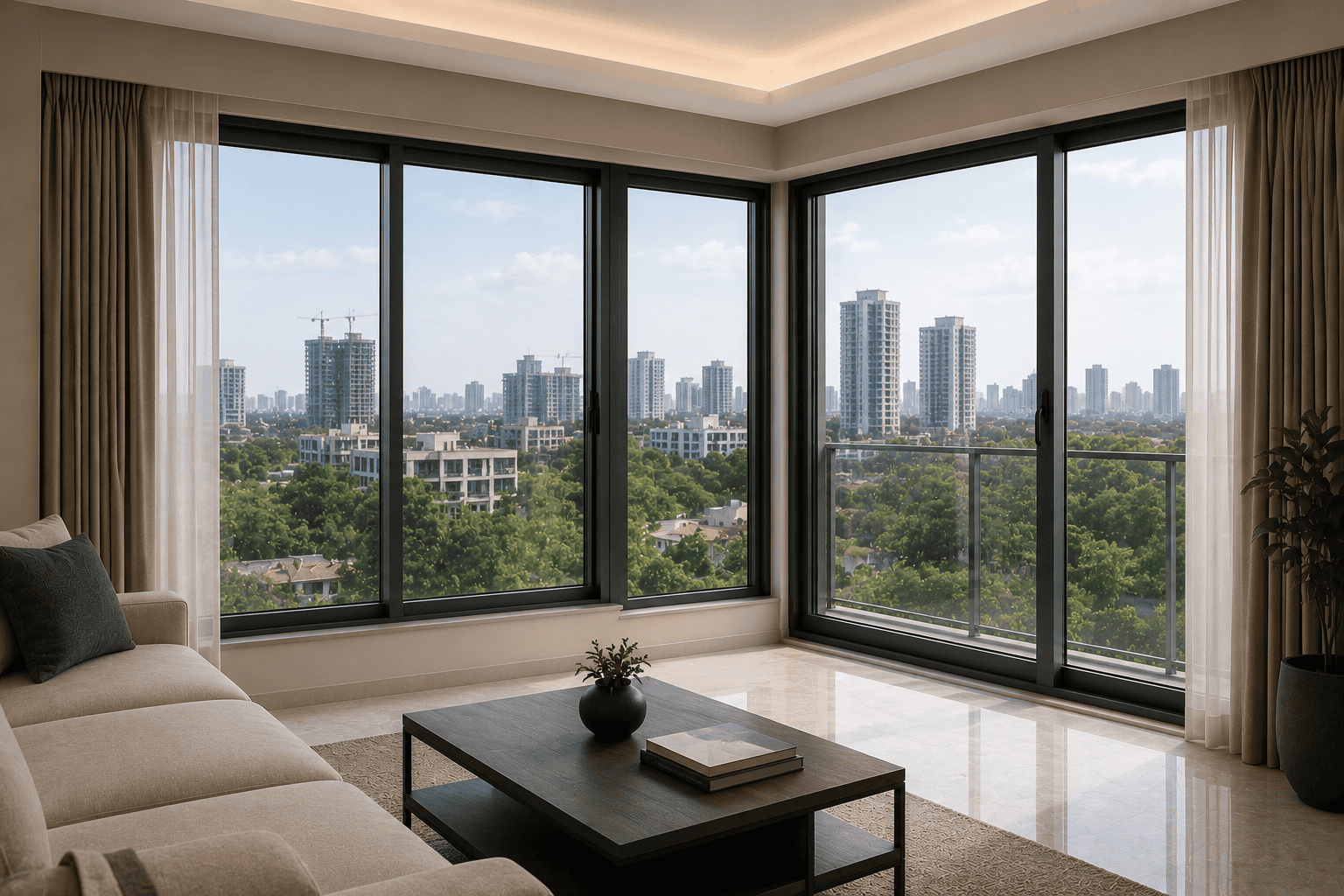
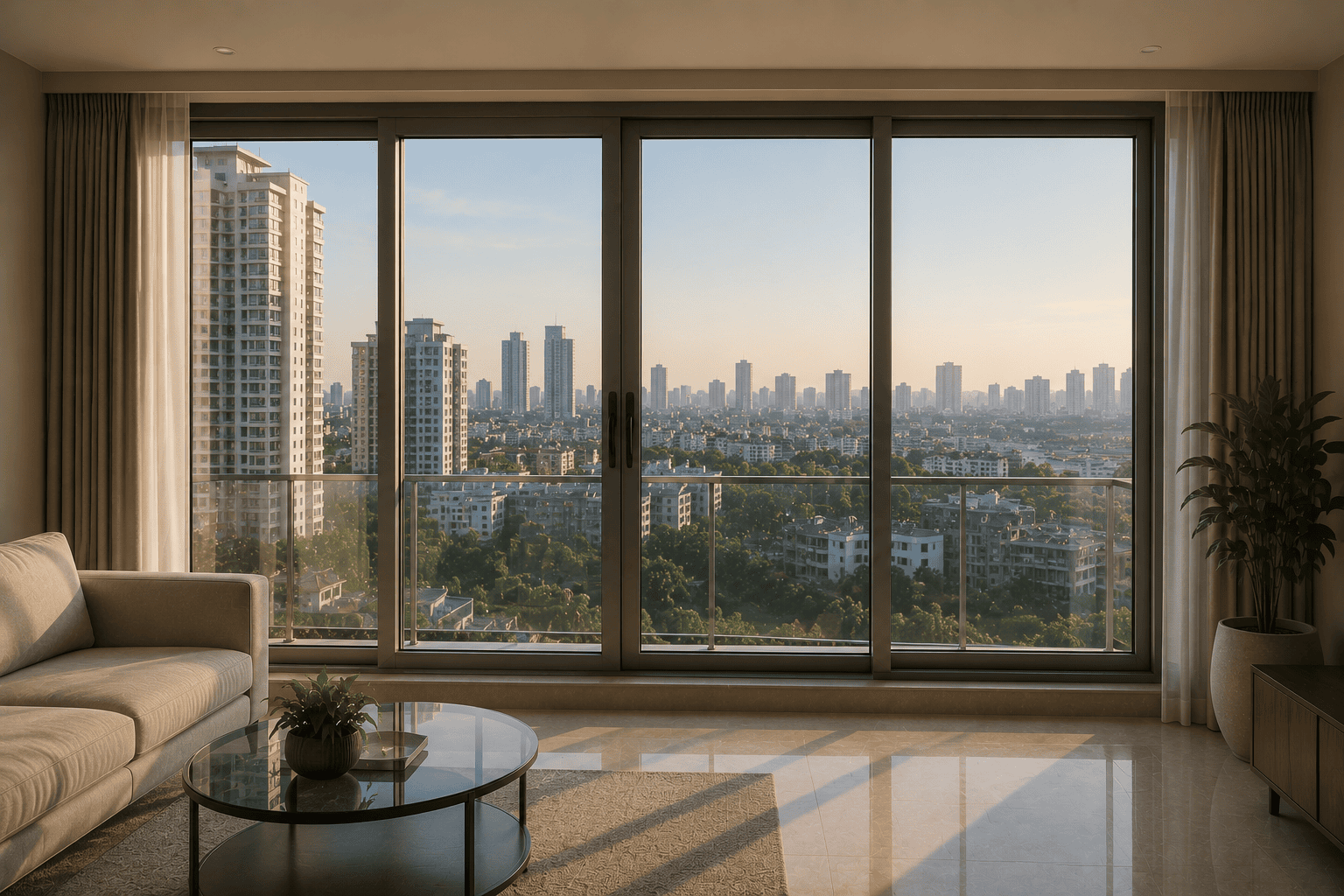
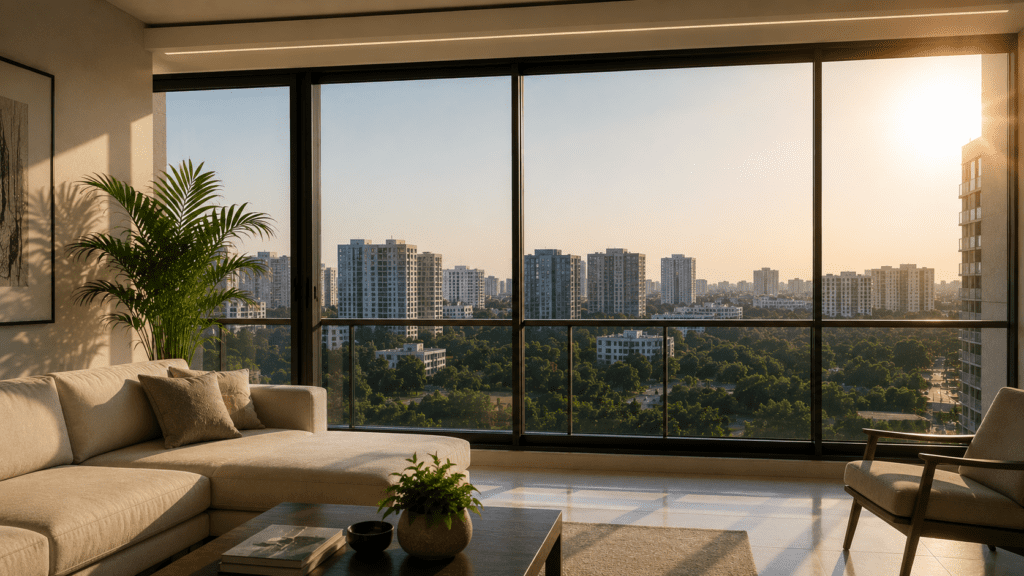
There is a particular frustration that Ahmedabad homeowners know well. You’ve invested in a flat with good windows — maybe a west-facing living room that catches the afternoon light and looks across the SG Highway skyline. And then May arrives.
By 2 PM, the room is hot enough that the AC is running at full blast and still struggling. The practical solution everyone reaches for is the same: heavy curtains, drawn shut. The light is gone. The view is gone. The reason you chose that apartment — the natural light, the sense of openness — has been sacrificed to manage the heat.
This trade-off is not inevitable. It is the consequence of a window specification that was never designed to do both at once. The good news is that the technology to solve it has existed for decades. The question is why it hasn’t been standard in Ahmedabad’s housing market until now.
Why Standard Glass Forces You to Choose
Standard clear glass — and standard tinted glass — transmit solar radiation across all wavelengths approximately proportionally. Heat and light arrive together, in roughly fixed ratios, and you cannot separate them using the glass alone.
The sun’s energy that reaches your window arrives in three forms:
- Visible light (about 44% of solar energy) — the light you want
- Near-infrared radiation (about 53% of solar energy) — the heat you don’t want
- Ultraviolet radiation (about 3%) — the portion that fades furnishings
Standard clear glass allows approximately 85–90% of visible light through and approximately 65–70% of total solar energy (heat included) through. You get good light, but you also get significant heat — they arrive together because the glass doesn’t distinguish between them.
Standard tinted glass reduces both: it blocks some visible light and some heat, proportionally. You get a darker room and a slightly cooler room. The trade-off is not resolved — it’s just managed at a lower level of both.
This is why many Ahmedabad apartments with darker glass feel gloomy even while still being uncomfortably warm in summer. The tinting is cutting light more than it’s cutting heat, because the glass doesn’t distinguish.
What Low-E Glass Does Differently — The Answer-First Explanation
Low-E (low-emissivity) glass uses a microscopically thin metallic oxide coating that selectively reflects near-infrared radiation (heat) while transmitting visible light. It does what standard glass cannot: separate the two.
The coating works because visible light wavelengths and near-infrared wavelengths interact differently with certain metallic surfaces. A properly tuned Low-E coating is essentially transparent to visible light but highly reflective to the infrared wavelengths that carry heat energy.
The practical outcome for an Ahmedabad west-facing room:
Standard clear glass:
- Visible Light Transmittance: ~83%
- SHGC: ~0.65 (65% of total solar energy enters as heat)
- Room condition in summer: bright and hot
Standard tinted glass:
- Visible Light Transmittance: ~45–55%
- SHGC: ~0.45–0.50
- Room condition in summer: darker and still warm
Low-E soft-coat double glazing (correct specification for Ahmedabad west-facing):
- Visible Light Transmittance: ~60–65%
- SHGC: ~0.24–0.28
- Room condition in summer: well-lit and meaningfully cooler
The Low-E specification delivers more natural light than tinted glass while blocking more heat. It is not a compromise between the two — it is a technical resolution of the problem that tinted glass cannot achieve.
The Frame Contribution: The Half of the Equation Most Suppliers Miss
Low-E glass solves the heat-through-glass problem. It does not solve the heat-through-frame problem, which is a separate and independent source of heat gain that most window buying conversations in Ahmedabad completely overlook.
A standard aluminium frame conducts heat directly from its hot outer face to its cooler inner face — at a rate approximately 700 times faster than the thermal break material used to interrupt it. On a west-facing Ahmedabad wall in May, this conducted heat is constant: it arrives through the frame perimeter all afternoon, regardless of how good the glass is.
The thermal bridge in the frame is why some rooms with apparently good windows still feel warm near the window edge, even after the glass has been upgraded. The glass is performing. The frame is failing.
A thermally broken frame eliminates this contribution entirely. The polyamide strip prevents the temperature differential from conducting inward — the inner frame face stays close to room temperature, and the zone near the window no longer feels warmer than the rest of the room.
The complete solution for Ahmedabad’s solar gain problem is:
- Low-E glass: addresses heat entering through the glass area
- Thermal break frame: addresses heat entering through the frame perimeter
Both are required. Specifying either without the other leaves a measurable gap in performance.
Ahmedabad Orientation-by-Orientation Guide
Not all windows in your home need the same specification. Here is how to think about glass selection by orientation — which is the advice Thermaline® gives every client before specifying, and which most Ahmedabad suppliers skip because it requires knowing more than one product:
West-facing rooms (priority 1 in Ahmedabad) Maximum solar exposure from 1 PM to sunset — exactly when Ahmedabad hits its daily temperature peak. Specify Low-E double glazing with SHGC 0.23–0.27 and VLT 60–65%. This is the specification that makes a west-facing Ahmedabad room genuinely liveable in summer without curtains.
South-facing rooms Direct sun from late morning through midday. SHGC 0.27–0.32, VLT 60%+. Slightly more solar warmth in winter than the west-facing specification, which is useful during Ahmedabad’s cool January mornings.
East-facing rooms Morning sun at low angles — problematic for bedrooms where glare at 6–8 AM interrupts sleep and morning comfort. SHGC 0.30–0.35, and consider whether acoustic laminated glass is also needed (east-facing Bopal or Prahlad Nagar apartments often face traffic arterials). VLT 60%+ to maintain bright morning light without the low-angle glare.
North-facing rooms No direct solar radiation falls on north-facing facades in Ahmedabad. This is your daylighting-first orientation — prioritise high VLT (65%+) with moderate solar control. If the north face overlooks a road or commercial zone, acoustic laminated glass may be worth specifying.
Courtyards and skylights Many Ahmedabad bungalows and duplex villas have internal courtyards with overhead glazing. These are high solar gain areas that need SHGC specification closer to the west-facing recommendation — 0.25 or below — because overhead glazing receives near-vertical sun at peak intensity.
Why AluPure and Prominance Don’t Answer This Question for Ahmedabad Buyers
The orientation-specific glass conversation requires a supplier who understands the performance interaction between glass coating, frame specification, and local solar angles. It requires more than a catalogue.
AluPure’s thermal break minimal system is set to be introduced — which means that for Ahmedabad buyers seeking a thermal break frame with orientation-tuned Low-E glass today, AluPure’s product readiness has limitations. Their product range references quality and customisation, but orientation-specific SHGC guidance for Ahmedabad’s climate zones is not part of their documented content.
Prominance operates in Ahmedabad’s uPVC segment. uPVC’s thermal properties are reasonable, but uPVC cannot carry the large glass panel sizes that Ahmedabad’s premium bungalow and apartment market increasingly specifies for courtyards, living rooms, and balcony enclosures. The orientation-specific glass + thermal break combination is not available in uPVC at the scale and structural depth that modern Ahmedabad residential architecture demands.
ALCOI does not appear to have an Ahmedabad-specific service presence or any published orientation guidance for Gujarat’s climate.
Thermaline®’s Approach: Specification by Orientation, Not by Catalogue
At Thermaline®, we start every Ahmedabad residential project with the building’s orientation plan — which rooms face west, which face south, which face north — and specify the glass for each orientation independently. The thermal break frame is standard across the building; the glass varies by the solar brief of each facade.
Our EcoCasement® systems for Ahmedabad bungalows and EcoSlide® systems for apartment large openings are available with Low-E glass specifications calibrated for Ahmedabad’s solar angles, summer peak temperatures, and the specific heat management brief that Gujarat’s hot and dry climate demands.
This is not a premium service. It is how fenestration should always be specified. The difference in thermal performance, comfort, and natural light quality between an orientation-tuned specification and a single-spec-for-all-windows approach is the difference between an Ahmedabad home that works and one that keeps the curtains closed.
Ready to specify your Ahmedabad home properly? Speak to Thermaline® for a free orientation assessment and glass specification review. The consultation is free. Five months of closed curtains is not.
