
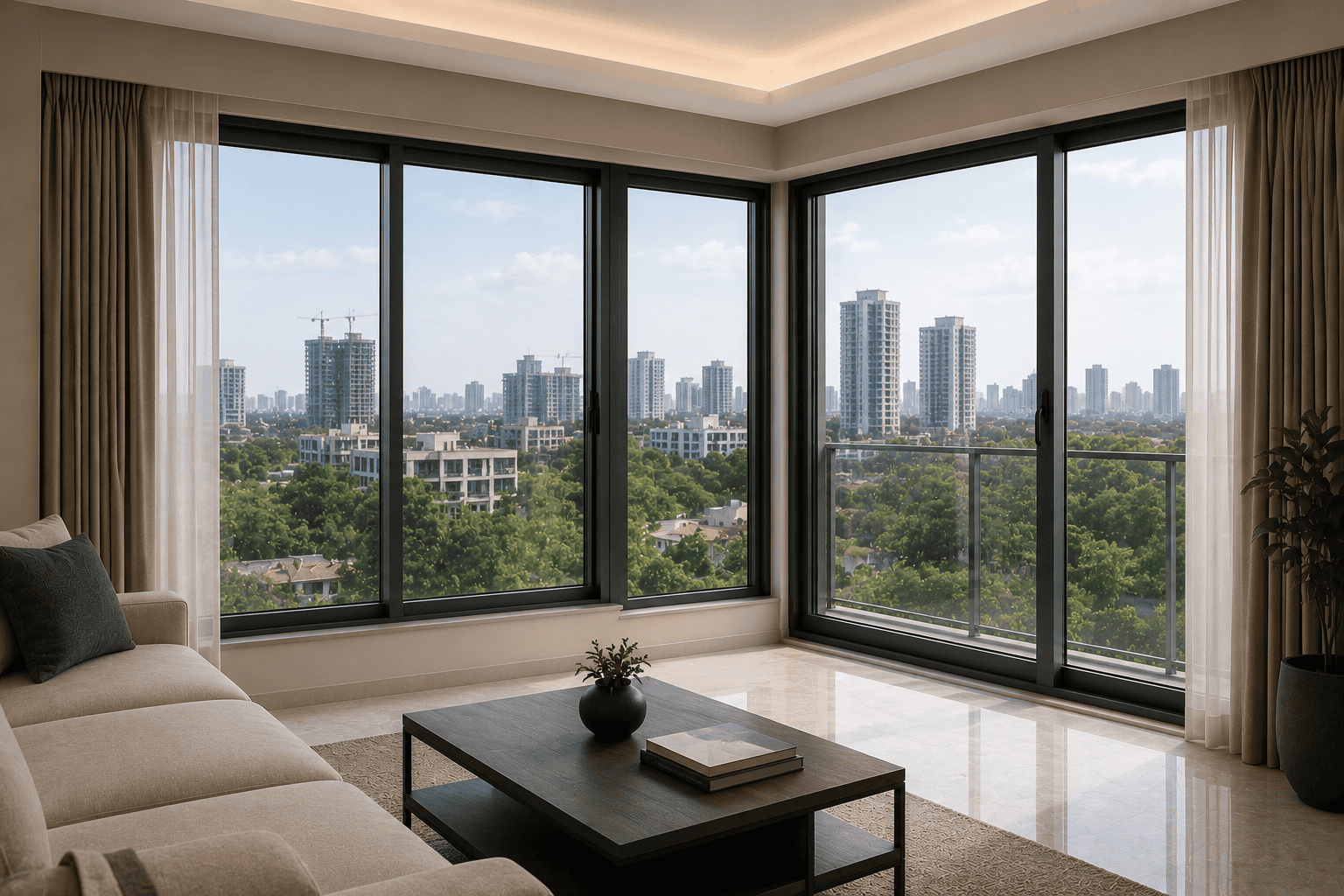
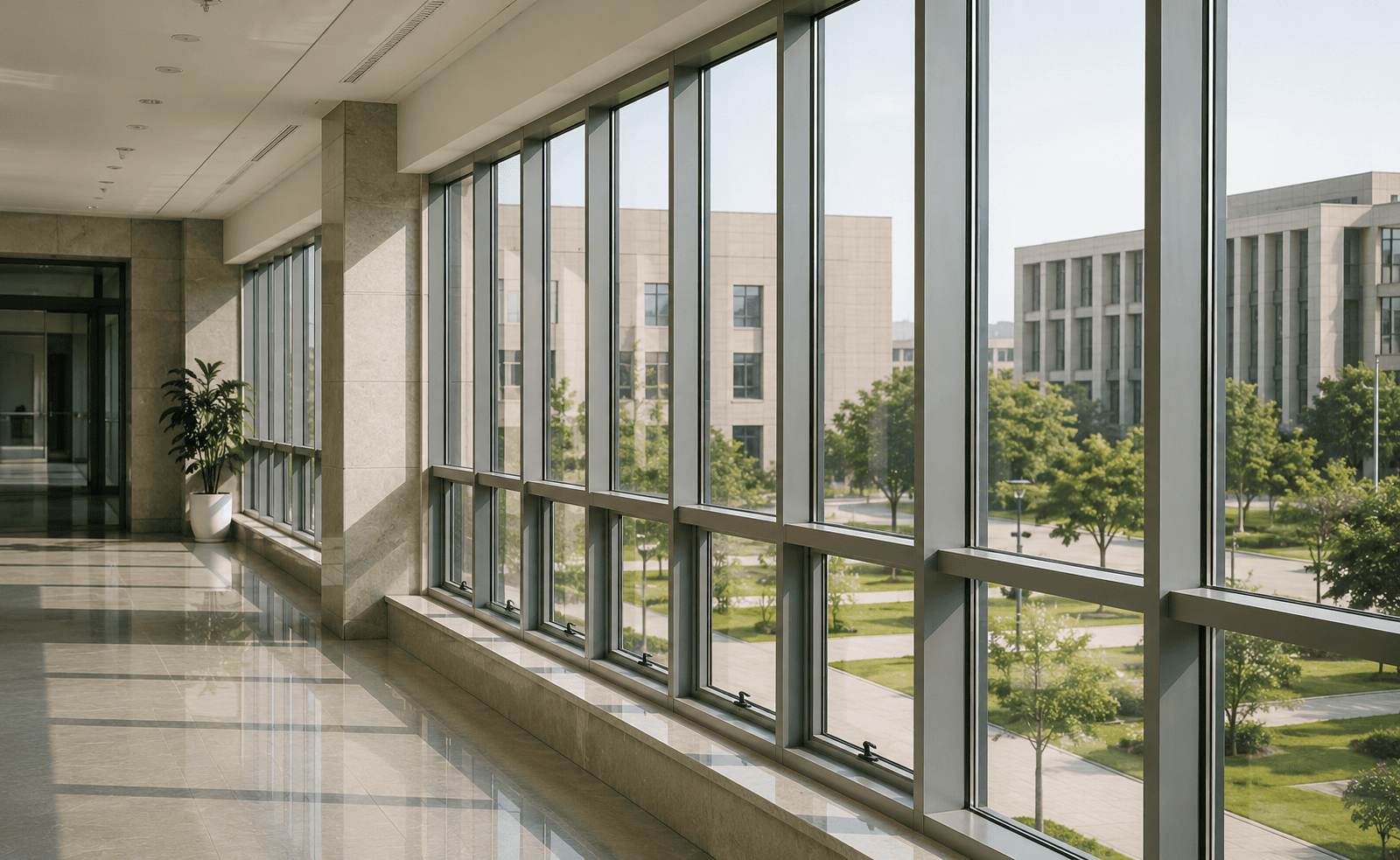
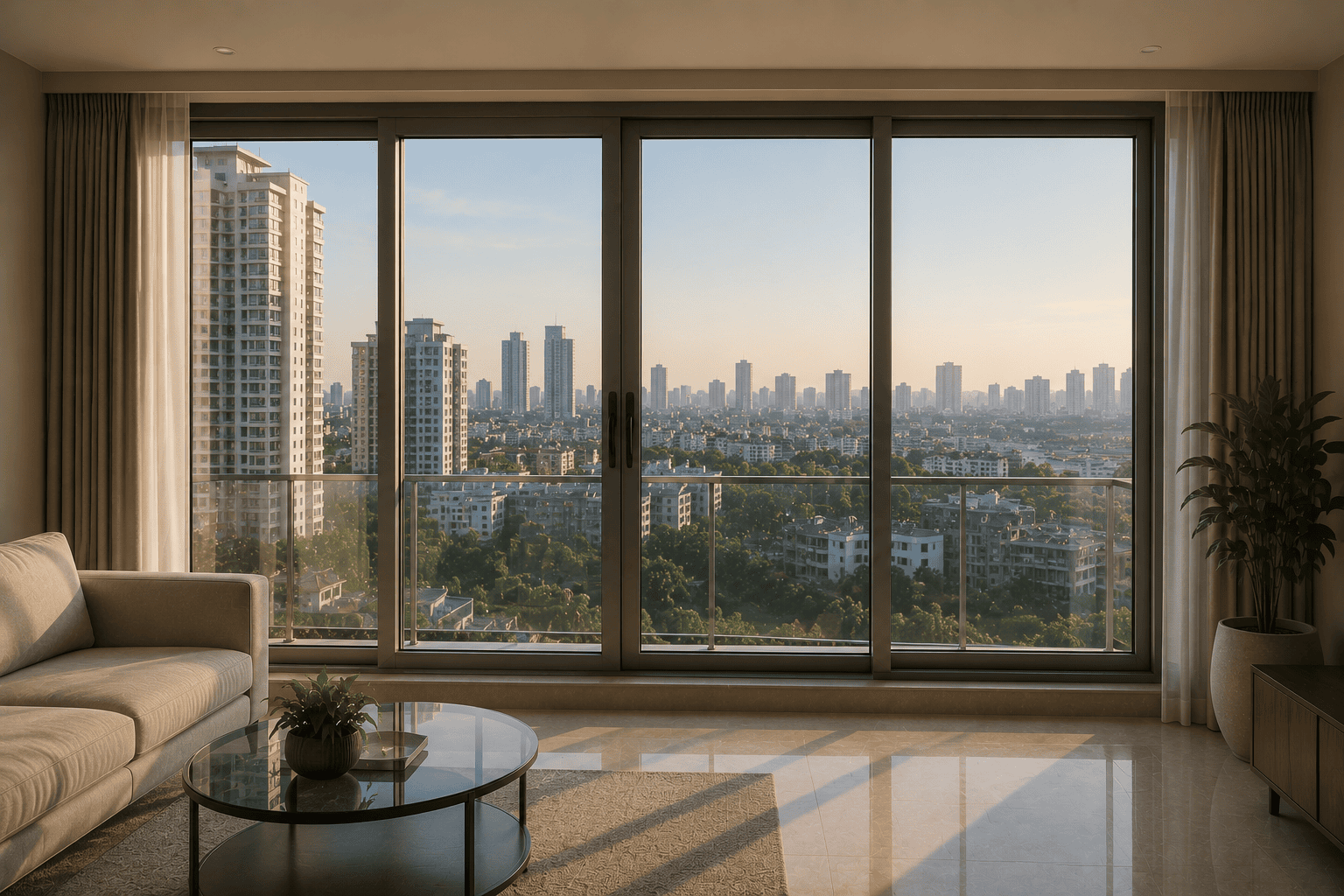
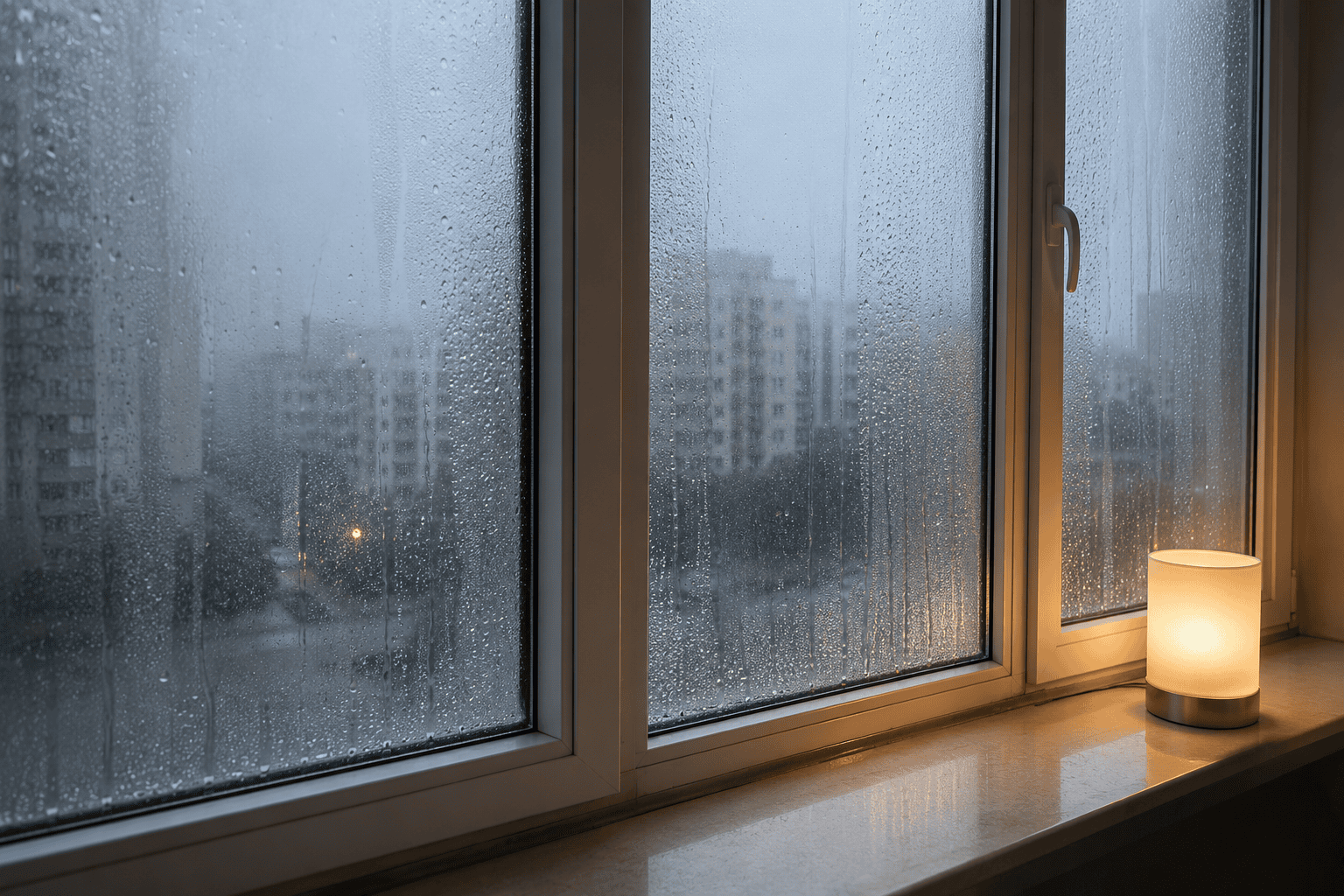
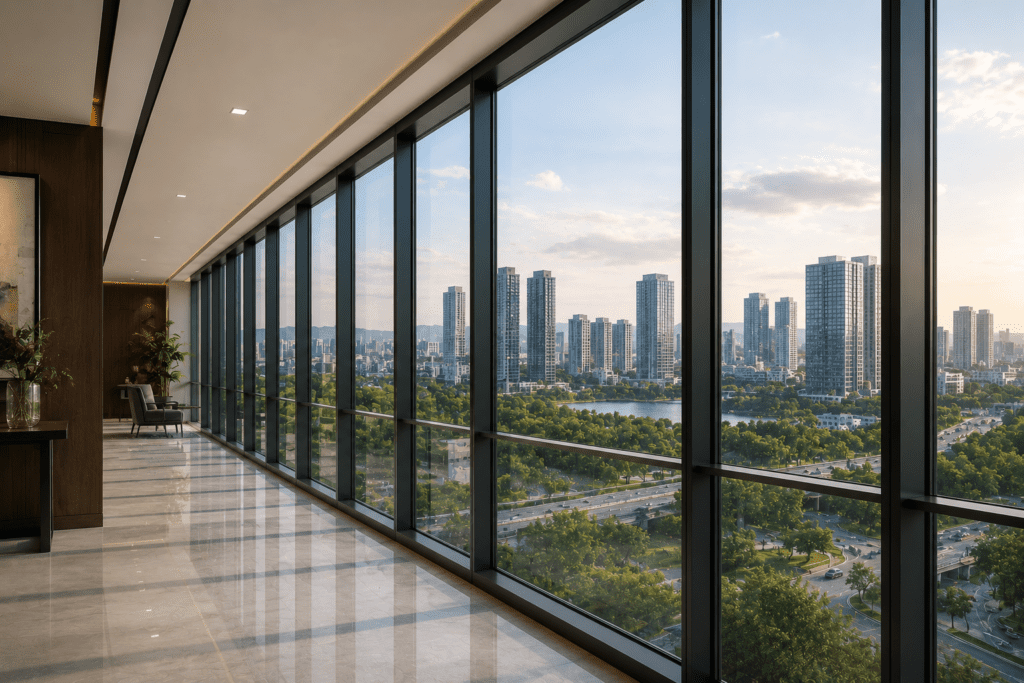
Hyderabad’s western corridor — the arc running from Madhapur through Kondapur, Gachibowli, and the Financial District — has become one of India’s most active premium residential markets. My Home Bhooja, Cybercity Marina Skies, and a dozen other premium towers have raised both the skyline and the expectations of what a Hyderabad apartment should feel like.
But there’s a detail in almost every premium project in this corridor that buyers discover too late: the windows were specified for procurement efficiency, not for how Hyderabad actually feels to live in.
This isn’t a minor issue. Hitech City and Gachibowli have a specific climate and acoustic profile that standard builder-grade windows are genuinely poor at managing. Understanding what your windows need to do in this location — before you commit to a project or start a renovation — is the difference between an apartment that performs as well as it looks and one that runs its AC continuously without ever quite cooling down.
Hyderabad’s Climate Is Not What Most Window Specs Account For
Hyderabad sits at 536 metres elevation on the Deccan Plateau — which gives it a climate that surprises people unfamiliar with it. It is hot, but not as relentlessly humid as Mumbai. It is dry enough in its pre-monsoon peak that temperatures feel like a furnace rather than a sauna. And from March through June, the city bakes with a directional intensity — the sun’s angle and the ORR’s heat island effect combine to make west and south-facing apartments genuinely uncomfortable without proper thermal management at the window line.
The Hitech City and Gachibowli corridor specifically has additional factors:
The PVNR Expressway and ORR noise corridor. Towers in Gachibowli and along the Financial District stretch face significant traffic noise from the Outer Ring Road and the PV Narasimha Rao Expressway — one of Hyderabad’s busiest arterial routes. For apartments above the 8th floor on the eastern and northern faces of towers in this zone, highway noise is audible through closed standard windows at late hours.
Large west-facing glass areas. Many of Hitech City and Gachibowli’s premium towers are designed with large floor-to-ceiling or near-floor-to-ceiling west-facing living rooms — positioned to capture the Durgam Cheruvu lake view or the Biodiversity Park greenery to the west. From an aesthetics standpoint this is excellent. From a thermal standpoint, a west-facing room with standard clear glass and no thermal break in the frame is receiving direct solar radiation from 2 PM to sunset — exactly when Hyderabad’s summer temperatures are at their peak. The AC in these rooms rarely settles.
High-rise wind exposure. The taller towers in the Gachibowli Financial District and the Madhapur premium cluster reach 25–35 floors. At these heights, wind load on windows is substantially higher than what standard residential-grade aluminium frames are designed for. Frame flex under wind creates seal gaps — and seal gaps mean dust infiltration, which Hyderabad’s pre-monsoon months deliver in abundance.
What to Look for When Evaluating a Project’s Window Specification
Most buyers in the ₹1.5–5 crore range in this corridor focus on the kitchen brand, the lobby, and the view. Fewer ask the developer’s sales team for the window specification sheet — and even fewer know what to do with one if they get it.
Here’s a practical guide to evaluating what you’re being offered:
Ask if the frame is thermally broken. This single question separates the majority of builder-grade specifications from high-performance ones. A thermally broken frame has a reinforced polyamide strip that prevents heat from conducting through the aluminium from outside to inside. Standard frames do not. In a west-facing Gachibowli apartment in May, the difference is measurable in both room temperature and electricity consumption. If the sales team doesn’t know the answer, the frame is probably standard.
Ask for the glass U-value and SHGC. U-value measures how much heat transfers through the glass unit. SHGC (Solar Heat Gain Coefficient) measures how much solar radiation the glass lets in. For a west-facing Hyderabad apartment, SHGC should be below 0.35. For the overall glazing unit, U-value should be below 1.5 W/m²K. Standard clear double glazing typically has SHGC around 0.65–0.70 — nearly double what a properly specified Hyderabad apartment should have.
Ask about the seal specification. The compression seal between the frame and the glass, and the three-layer perimeter seal between the frame and the wall, are where dust infiltration and monsoon water ingress either happen or don’t. Ask specifically what seal type is used and whether the frame-wall joint has a formal specification. A supplier who cannot describe the perimeter seal specification in detail is not offering a high-performance installation.
Check the hardware for stainless steel specification. Hyderabad is not a coastal city, but its summer heat, pre-monsoon dust, and monsoon humidity are enough to corrode standard zinc alloy window hardware within 3–5 years. Premium towers in this corridor are priced at premium rates — the hardware should be stainless steel or quality marine-grade aluminium alloy.
Why Competitors Are Gaining Ground in Hyderabad — and What Thermaline® Does Differently
Brands like ALCOI and AluPure are becoming more visible in Hyderabad’s premium market, and the reason is straightforward: buyers now evaluate whole-system performance — sealing, drainage, and hardware quality — not just the frame cost. Specifiers look for verified air/water/wind ratings, multi-gasket sealing strategies, stainless steel rollers and tracks, and corrosion-resistant hardware.
This is the right framework. But there is a critical difference between a brand that has engineered for Indian climate conditions from inception and one that has adapted European systems for the Indian market.
AluPure, a German brand under Profine GmbH, brings European design DNA to India — which means their baseline engineering is for Central European conditions. India-specific adaptations exist, but the fundamental system was not designed with Hyderabad’s 43°C summers, monsoon humidity swings, and Deccan Plateau dust storms as the primary brief.
Thermaline® has spent over 20 years with that exact brief as the starting point. Our EcoSlide® and EcoCasement® systems are engineered specifically for Indian climate zones — including Hyderabad’s combination of dry summer heat, seasonal dust, and high-rise wind exposure. The glass specifications we recommend for west-facing Hitech City towers are different from what we recommend for a north-facing Gachibowli apartment, because the brief is different. That India-first approach is what separates a window that performs for 20 years from one that looks right on paper.
Neighbourhood-Specific Guidance for Hyderabad’s IT Corridor
Madhapur & Hitech City core: Noise from Cyber Towers Road and the metro construction corridor is a primary concern. Acoustic laminated double glazing in a thermal break frame is the specification for street-facing and lower-floor units.
Kondapur & Kothaguda: Predominantly residential with some traffic exposure. Thermal performance for west-facing rooms is the headline requirement. Low-E double glazing with thermal break frames.
Gachibowli & Financial District: High-rise, premium towers with ORR exposure. Wind load rating matters here — frame structural specification is as important as glass. Request the system’s wind load certification before specifying.
Narsingi & Manikonda: Growing mid-premium corridor. Builder-grade specifications are common at this price point. Buyers doing renovation upgrades have the highest opportunity to improve performance significantly over the builder default.
The CTA That Actually Protects Your Investment
A ₹2 crore apartment in Gachibowli with builder-grade windows is a ₹2 crore investment with a preventable performance gap. The window upgrade cost — whether at the point of purchase (as a negotiation item with the developer) or during the first renovation cycle — is a fraction of the property value, and it determines how the apartment feels to live in for the next 20 years.
Thermaline® offers site-specific consultations for Hyderabad IT corridor apartments — assessed by floor level, orientation, and building type. If you’re in pre-purchase due diligence or planning a renovation in Hitech City, Gachibowli, Kondapur, or Madhapur, speak to our team before you finalise the specification.
The consultation is free. Replacing the wrong windows twice is not.
