

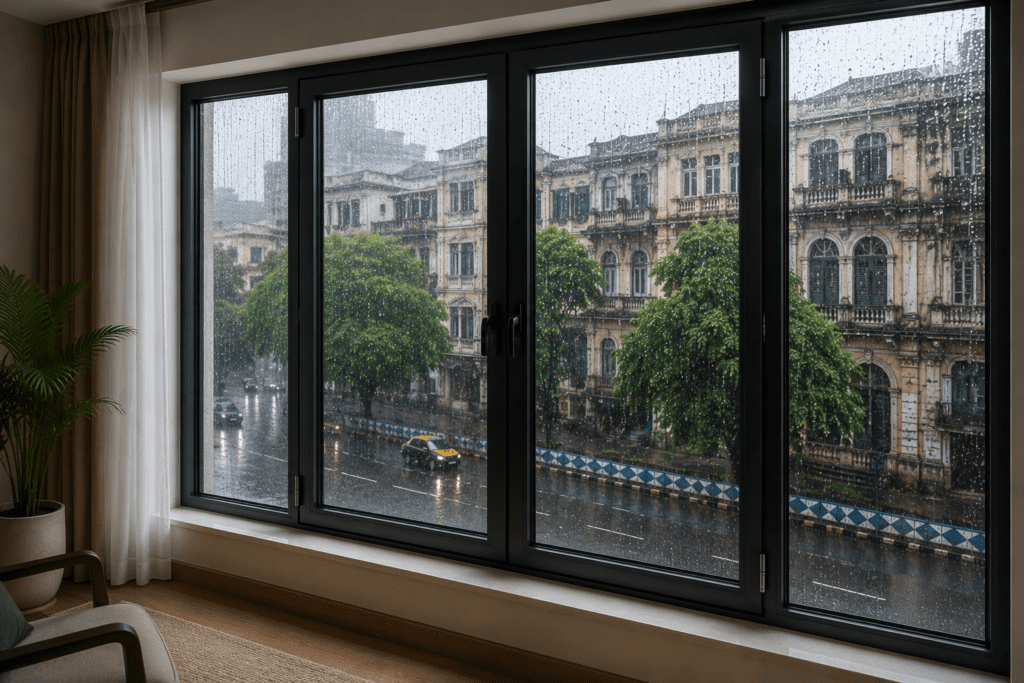
On September 23, 2025, Kolkata came to a complete standstill. In a 24-hour period, the city recorded its third-highest single-day September rainfall since 1978 — an average of 251 mm citywide, with Garia Kamdahari recording 332 mm, Jodhpur Park 285 mm, Kalighat 280 mm, and Ballygunge 264 mm. Universities suspended classes. The metro was disrupted. Thirty flights were cancelled. The Eastern Metropolitan Bypass, Central Avenue, and Rashbehari Avenue flooded. Chief Minister Mamata Banerjee announced the Durga Puja vacation three days early because of conditions on the ground.
This was not an anomaly that planners and scientists expect to fade. Climate researchers studying Kolkata’s rainfall patterns note that the Bay of Bengal has been warming faster than the global average — drawing in more atmospheric moisture and producing more intense, compressed rainfall events. What happened in September 2025 is, in all likelihood, a preview of what becomes increasingly routine.
For Kolkata homeowners, this changes the stakes of the window decision entirely. A window that performs adequately against average monsoon conditions — the moderate, sustained daily rainfall of a typical July or August — may fail catastrophically in the kind of concentrated, high-intensity event the city is now being asked to prepare for. Knowing what distinguishes one from the other is no longer a technical nicety. It’s a practical necessity.
Why Kolkata’s Climate Creates a Unique Window Stress Profile
Kolkata’s monsoon challenge for windows is defined by three compounding factors that most standard window specifications don’t address simultaneously: extreme rainfall intensity, high ambient humidity through the full monsoon period, and the thermal movement that precedes and follows the rains.
The rainfall intensity factor is documented and worsening. The September 2025 cloudburst — nearly 100mm in a single hour at peak intensity, just below the meteorological cloudburst threshold — puts pressure on window systems in ways that test conditions never simulate. Window drainage systems sized for typical monsoon rainfall cannot evacuate water at 100mm/hour rates. Bottom tracks fill. Water backs up into the room.
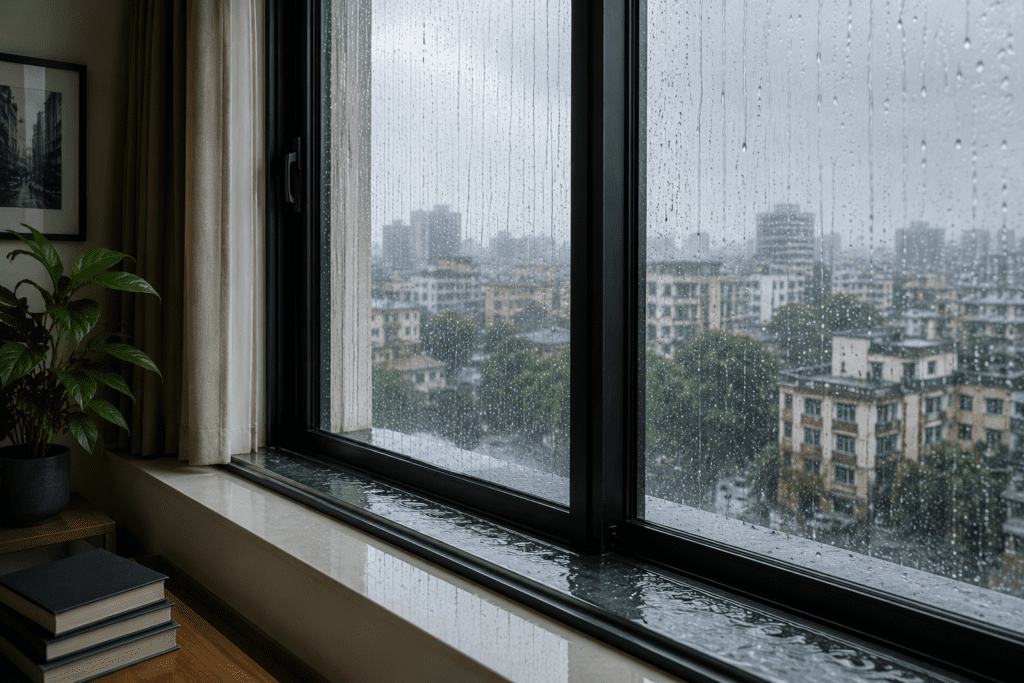
The humidity factor is less dramatic but relentless. Kolkata’s pre-monsoon humidity — the dense, pressing atmosphere of May and June that arrives before the first rains — sits at 70–80% relative humidity for weeks. This sustained humidity causes two things in standard aluminium windows: it accelerates the degradation of sealants at the frame-wall joint, which are designed for occasional exposure rather than continuous saturation; and in windows with standard brush seals, it causes the bristles to absorb moisture, lose compression, and gradually stop sealing effectively.
The thermal movement factor is the one most often overlooked. Kolkata experiences genuinely significant temperature variation between its summer peak (38–40°C in May) and its winter minimum (10–12°C in January). This 28-30°C annual range causes standard aluminium frames to expand and contract repeatedly — stressing corner joints, degrading seals, and creating micro-gaps that become water infiltration pathways precisely when the monsoon arrives to test them.
What “Won’t Warp or Leak” Actually Requires: The Technical Answer
A window system that resists Kolkata’s monsoon conditions across multiple seasons — not just when new — needs to address four engineering elements simultaneously.
1. Multi-point compression seals, not brush seals
This is the most critical specification for Kolkata’s monsoon performance. A compression seal — a continuous rubber gasket compressed against the window panel by multi-point locking hardware — maintains consistent sealing pressure even as wind direction and intensity vary during a monsoon storm. A brush seal performs reasonably in calm conditions but loses effectiveness under wind-driven rain and gradually degrades in Kolkata’s sustained humidity.
Ask your supplier specifically: is this a compression seal or a brush seal? The answer tells you more about monsoon performance than any marketing claim.
2. Drainage channel capacity rated for high-intensity rainfall
Standard sliding window bottom tracks have drainage ports sized for typical rainfall patterns. For Kolkata’s high-intensity cloudburst events — where rainfall rates can approach 100mm/hour — standard drainage port sizing is often inadequate. Water accumulates in the bottom track faster than it can exit, and eventually overflows into the room.
Ask for the drainage capacity specification. A properly designed track for Kolkata’s conditions should include enlarged drainage ports, no upstand lip that holds water, and a track slope that directs water efficiently to the drainage exit.
3. Thermal break frame construction — the seal-longevity benefit
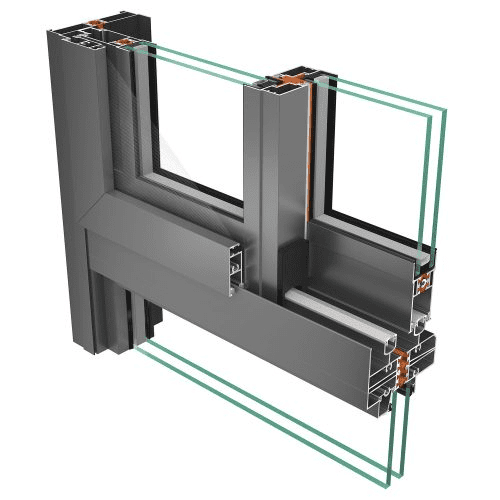
A thermally broken aluminium frame experiences less thermal cycling stress than a standard aluminium frame across Kolkata’s seasonal temperature range. The outer and inner frame sections expand and contract independently, each experiencing a smaller temperature differential than a single-piece aluminium frame. This reduced cycling stress means the seals and coatings at corner joints and frame interfaces degrade more slowly — maintaining their performance across more monsoon seasons before requiring attention.
This is not primarily a heating or cooling benefit for Kolkata (where the temperature extremes are less severe than Delhi or Ahmedabad). It is a seal-longevity and structural integrity benefit — which directly translates to monsoon performance that holds up over years, not just the first season.
4. Three-layer perimeter sealing at the frame-wall joint
The joint between the window frame and the surrounding wall opening — typically 5–20mm wide after installation — is the most common source of water infiltration in Kolkata apartments, and the one least likely to be specified with adequate care by standard installation teams.
The correct specification is: polyurethane foam to fill the void, vapour-permeable membrane tape on the exterior face to block water while allowing trapped moisture vapour to escape, and a quality polyurethane sealant bead on the interior finish. In Kolkata’s conditions — where this joint is saturated for 4–5 months per year — a single silicone bead applied as standard practice typically shows adhesion failure within 4–6 years, creating a water pathway that becomes visible as interior damp staining around the frame.
The Warping Question: Why Timber and Standard Aluminium Both Fail Kolkata
The headline of this blog addresses warping specifically, and it deserves a direct answer.
Timber windows warp in Kolkata’s monsoon because wood absorbs moisture, expands during the humid season, and contracts during the dry winter. Over years, this seasonal cycling causes irreversible dimensional change — panels that no longer close flush, gaps that can’t be sealed, and frames that bind against their tracks.
Standard aluminium doesn’t warp in the timber sense. But it does something functionally similar: it deflects under thermal and mechanical load in ways that compromise seal integrity. A large aluminium sliding panel on an undersized track, expanded by Kolkata’s summer heat and then exposed to monsoon wind pressure, can flex enough to break the seal contact at the track and top rail — allowing water infiltration that looks exactly like warping-related leakage to the homeowner.
A thermally broken frame’s multi-chamber profile construction provides greater rigidity per millimetre of aluminium section than an equivalent standard single-chamber profile. This rigidity advantage directly reduces panel deflection under the combination of thermal expansion and wind load that produces pseudo-warping in standard systems.
Kolkata Neighbourhood Guide: Where the Monsoon Risk Is Highest
Southern and eastern Kolkata — Garia, Jodhpur Park, Kalighat, Ballygunge, Topsia — recorded the highest rainfall in the September 2025 event, in some cases exceeding 280mm in a few hours. These areas combine high rainfall intensity with relatively lower elevation, creating both external flooding and elevated in-building water pressure during peak events. Windows in these neighbourhoods face the most severe test conditions.
EM Bypass and Salt Lake / Bidhannagar: The Eastern Metropolitan Bypass closed during the September 2025 event — apartment towers along this corridor face combined high rainfall and, on exposed upper floors, significant wind-driven rain from the unobstructed flat terrain of eastern Kolkata.
Rajarhat and New Town: Built partly on reclaimed East Kolkata Wetland land, with poor natural drainage that exacerbates waterlogging every monsoon, new towers in this corridor face extended periods of elevated external water presence at window sill level in ground and lower floors.
Heritage South Kolkata (Bhowanipore, Tollygunge, Alipore): Older building stock with original or early-replacement windows that have been through decades of monsoon cycling without formal sealing maintenance.
What Thermaline® Provides That Competitors Don’t Specify for Kolkata
AluPure markets aluminium windows in Kolkata, referencing durability and German engineering standards. Their product documentation covers wind load capacity and weather resistance in general terms. What their Kolkata-specific content does not address: drainage capacity for cloudburst-intensity rainfall, thermal cycling seal longevity in Kolkata’s specific seasonal range, or the three-layer perimeter sealing methodology that determines whether the frame-wall joint holds across multiple monsoon seasons.
Prominance’s uPVC systems at their Strand Road Kolkata office provide monsoon resistance through material chemistry (uPVC does not corrode), but cannot match the structural rigidity of thermally broken aluminium at larger panel sizes — relevant as Kolkata’s premium apartments increasingly specify larger glass openings.
Thermaline®’s EcoCasement® and EcoSlide® systems are specified for Kolkata’s actual monsoon conditions — with multi-point compression seals, drainage channels sized for high-intensity rainfall, thermal break frames that maintain seal integrity across Kolkata’s seasonal cycling, and an installation methodology that includes the three-layer perimeter seal as a standard, not an upgrade. Our 20+ year experience in Indian building conditions means we understand what a Kolkata monsoon actually does to a window — and how to engineer against it.
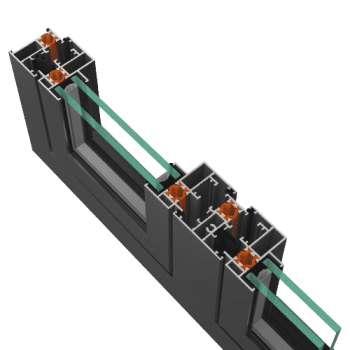
If your apartment or home has experienced any water infiltration during recent Kolkata monsoon seasons, speak to Thermaline® before the next one arrives. The assessment is free. The damp patch on your wall next September is not.
FAQs
What makes Kolkata’s window stress profile unique compared to other cities?
Kolkata’s monsoon challenge combines extreme rainfall intensity, high ambient humidity throughout the monsoon, and significant thermal movement between summer and winter, which together create a window stress profile not addressed by standard specifications. A cloudburst can deliver near 100 mm/hour, humidity accelerates seal degradation, and a 28–30°C annual temperature range causes repetitive expansion and contraction of frames, all testing windows beyond typical design conditions.
What four engineering elements must a window system address to resist Kolkata’s monsoon conditions across multiple seasons?
A window system must use multi-point compression seals rather than brush seals; drainage channels sized for high-intensity rainfall; thermally broken frame construction to reduce seal cycling stress; and three-layer perimeter sealing at the frame-wall joint to prevent interior water ingress during prolonged saturation.
Why do timber and standard aluminium windows fail under Kolkata’s monsoon conditions?
Timber windows absorb moisture and expand during humid seasons, then contract in the dry season, causing irreversible dimensional change and gaps. Standard aluminium can also fail by deflecting under thermal and wind loads, breaking seal contact and allowing water infiltration, especially when a large panel is on an undersized track.
What is the three-layer perimeter sealing specification for the frame-wall joint in Kolkata?
The correct specification is polyurethane foam to fill the void, a vapour-permeable membrane tape on the exterior face to block water while allowing moisture vapour to escape, and a high-quality polyurethane sealant bead on the interior finish. A single silicone bead is typically insufficient for extended monsoon saturation and can lead to interior dampness over years.
What advantage does Thermaline offer for Kolkata’s monsoon windows?
Thermaline provides EcoCasement and EcoSlide systems with multi-point compression seals, drainage channels sized for high-intensity rainfall, thermally broken frames to maintain seal integrity, and a three-layer perimeter seal as standard, delivering performance suited to Kolkata’s actual monsoon conditions.
