

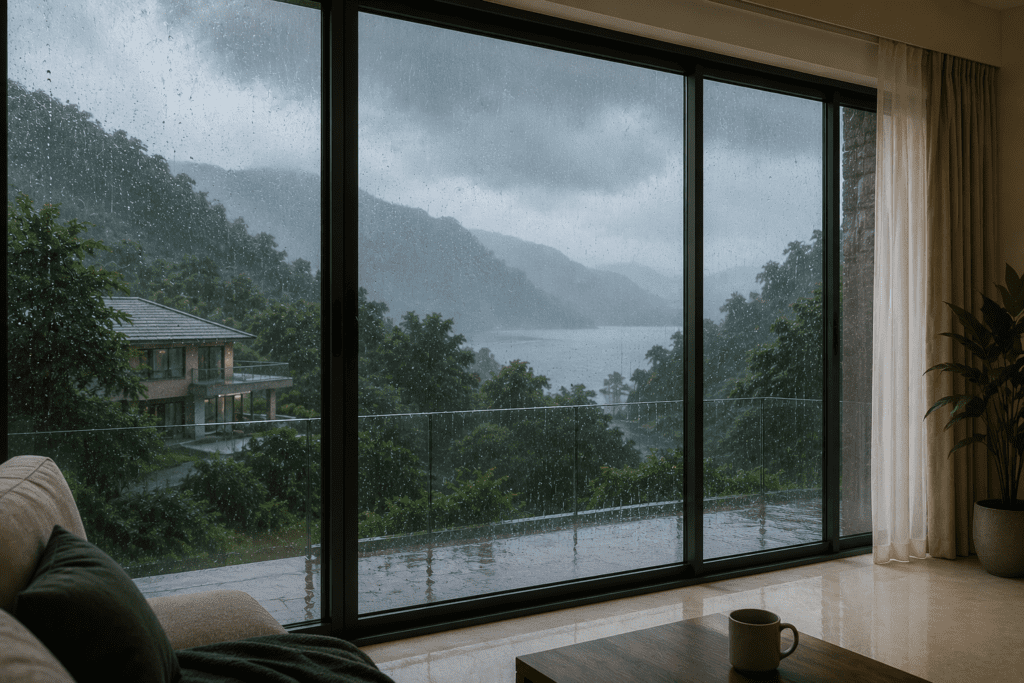
If you own a bungalow on the hills around Pune — Lavale, Baner Hills, Pashan Hills, Sus, or anywhere on the Pune-Mumbai Expressway corridor toward Lonavala — you already know what June brings. Not the gentle rain that postcards promise. The real thing: sustained sideways rain, gusts that rattle frames, and a monsoon that tests every seal, joint, and gasket your building has.
Pune’s Western Ghats geography is the reason. The city itself is relatively sheltered, but the moment you go to elevation — even 50 to 100 metres above the valley floor — you’re in a completely different wind and rain environment. The Sahyadri range channels and accelerates moisture-laden winds off the Arabian Sea. Hill bungalows in this zone can face wind-driven rain at speeds and angles that standard residential windows were never designed to handle.
The result, for homeowners who chose their windows based on aesthetics or builder defaults rather than performance specifications, is an unpleasant discovery — usually by the end of their first full monsoon.
What Monsoon Winds Actually Do to Windows
There’s a meaningful difference between rain-resistance and monsoon-resistance, and it matters a great deal in Pune’s hill zone.
Rain-resistance means a window performs adequately when water falls vertically and wind is light. This is the standard that most residential window testing accounts for, and it’s the standard most builders meet when they specify windows for a Pune bungalow project.
Monsoon-resistance — particularly at elevation — means the window must hold its seal when water is being driven horizontally at significant speed, sustained for hours at a time, and potentially during multiple consecutive days. The pressure differential between windward and leeward sides of the building can be substantial, and any weakness in the frame-glass seal, the frame-wall joint, or the hardware creates a path for water.
The specific failure modes in Pune hill bungalows are well-documented:
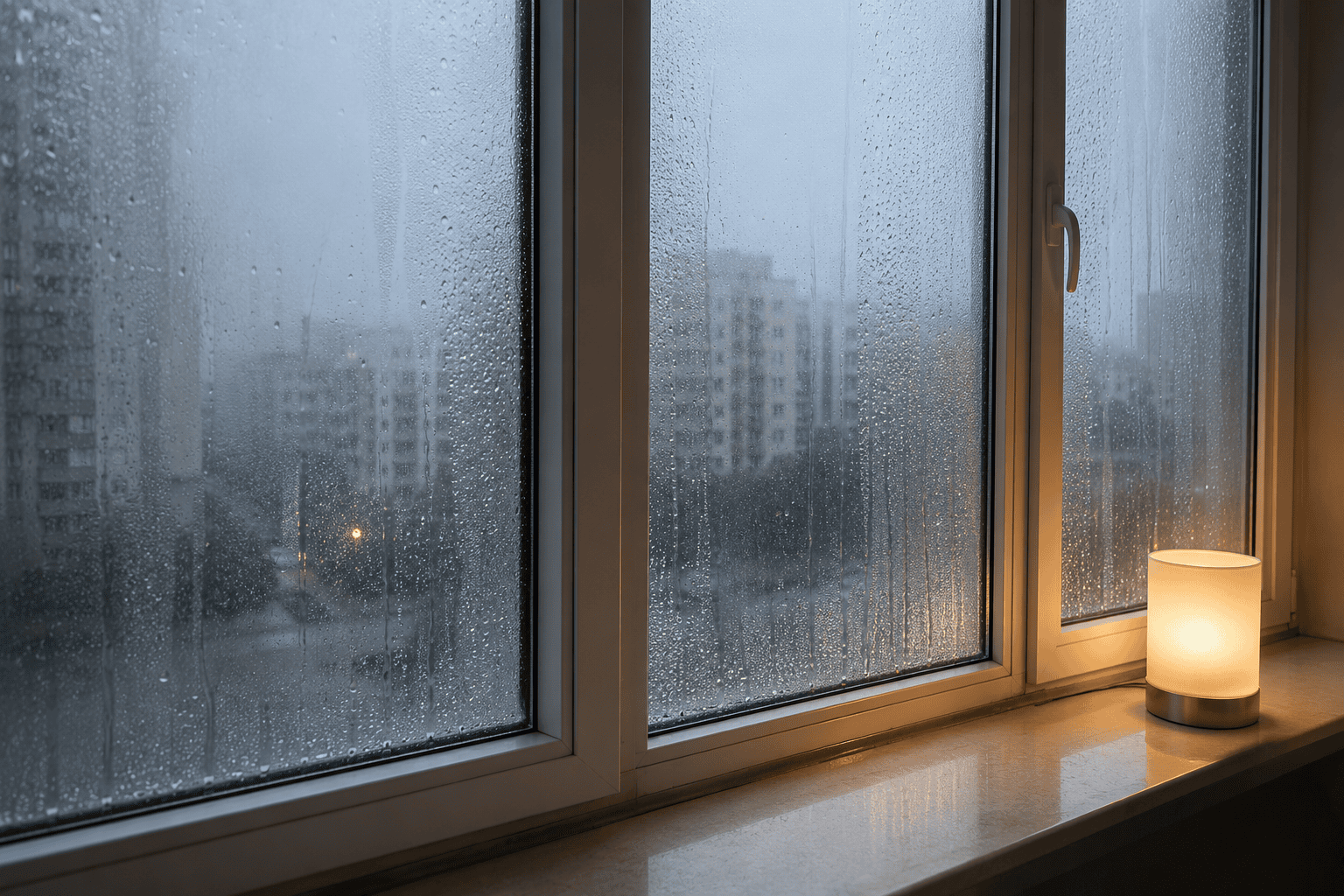
Water infiltration at the bottom rail is the most common. In a sliding window, the bottom track channels water when horizontal rain drives into the sill. Standard aluminium sliders with drainage ports sized for vertical rain cannot evacuate the volume of water from horizontal wind-driven rain fast enough, and the water backs up into the room.
Frame-wall joint failure is the second. The joint between the window frame and the surrounding wall — typically filled with mortar or silicone during installation — is the primary infiltration risk in older or budget installations. In hill bungalows that see high wind pressure every monsoon, this joint is stressed year after year. Cheap sealants crack and lose adhesion within 2–3 seasons. Once compromised, the joint allows water behind the interior plaster, where it causes damage that is expensive and disruptive to repair.
Hardware failure shows up more slowly. Hinges, handles, and locking mechanisms on budget aluminium windows begin showing corrosion within 2–3 monsoons in Pune’s hill zone, particularly on west-facing elevations that take direct exposure to the prevailing wind direction. Corroded hardware means windows that no longer shut flush — and a window that doesn’t close correctly cannot seal correctly.
The Wind Load Question: Why Frame Engineering Matters
Here is the technical point that most window buying conversations in Pune skip entirely: every window frame has a rated wind load, and that rating must match the actual wind exposure of your building.
For a bungalow at 700 metres elevation on the western slopes of the Sahyadri corridor — say, a property near Lonavala or on the Mulshi Lake belt — the wind loads during peak monsoon gusts significantly exceed what standard residential-grade aluminium frames are designed for. Standard residential windows are typically tested to wind load ratings appropriate for sheltered, valley-floor locations. They are not tested for the exposed slope conditions of Pune’s hill zones.
What does this mean in practice? Under sustained high wind pressure, an undersized aluminium profile flexes. The flex is small — invisible to the eye — but enough to break the compression seal contact at the frame perimeter. Water infiltration follows. And in frames that flex repeatedly across multiple monsoons, the profile itself can develop permanent deformation at the corners, where the structural stress concentrates.
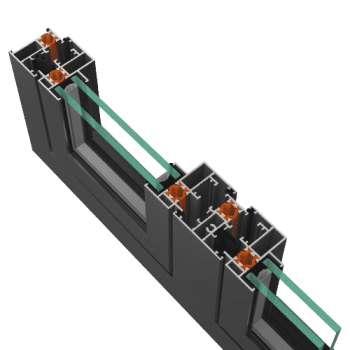
Thermally broken aluminium window profiles, by virtue of their construction — two separate profile sections joined by reinforced polyamide — have greater overall frame depth than equivalent standard aluminium profiles. This depth translates directly to greater rigidity and better wind load resistance. For Pune hill bungalows, this structural benefit is as important as the thermal performance.
What the Right Window System Looks Like for a Pune Hill Bungalow
For bungalows in Pune’s elevated zones — Lavale, Baner Hills, Wakad Hills, Sus Road, the expressway corridor, and the Lonavala-Khandala belt — the specification needs to address four things simultaneously:
Wind load rating appropriate for elevation. Ask any window supplier for the rated wind load of the system they’re proposing. For bungalows above 600 metres on exposed slopes, this should be specified to a higher standard than standard residential grade. Thermaline® can advise on the appropriate rating for your specific location.
Multi-point compression seals — not brush seals. The seal that runs around the perimeter of the window panel is the primary barrier against wind-driven rain. Multi-point compression seals maintain consistent contact pressure across the full frame perimeter even under wind load. Brush seals — the most common type in builder-grade sliding windows — compress irregularly and allow water ingress under lateral pressure.
Proper perimeter installation at the frame-wall joint. The joint between the window frame and the wall opening is where most Pune hill bungalow water infiltration problems originate. The correct specification is a three-layer system: PU foam backing, vapour-permeable tape on the exterior face, and quality polyurethane sealant on the interior. This needs to be specified and inspected — not left to the installation crew’s standard practice.
Quality stainless steel or marine-grade hardware. In Pune’s hill zones, the monsoon exposure is significant enough that standard zinc alloy hardware has a short performance life. Stainless steel handles, hinges, and locking mechanisms are the specification for longevity. A window that seals perfectly in year one but has corroded, loose hardware by year four is not a performance window.
Casement vs. Sliding: Which Works Better in Monsoon Conditions?
This is the question most Pune hill bungalow owners eventually reach. The short answer: casement windows have a structural advantage in monsoon conditions that sliding windows don’t.
A casement window — one that swings inward or outward on hinges — closes against a full-perimeter frame stop. When locked, the panel is mechanically compressed against the seal all around its perimeter. It is engineered to be shut.
A sliding window moves along a track and relies on the panel’s own weight, the track precision, and the brush or compression seals at the meeting stile and the top rail to seal. Under lateral wind pressure, this system has inherent weaknesses that casement windows don’t share.
For large openings in Pune hill bungalows where the view justifies the glass area, thermally broken casement windows — Thermaline®’s EcoCasement® system — provide the combination of generous glass area, slim profiles, and the mechanical sealing advantage that monsoon conditions demand. Where sliding windows are preferred for large openings, the specification moves up significantly in profile depth, seal quality, and drainage engineering.
A Practical Note on Older Bungalows in Pune’s Hill Zones
Many of Pune’s hill bungalows are 10–20 years old — built in the first wave of premium residential development in areas like Baner, Pashan, and Aundh Hills. The windows in these properties are approaching or past their practical performance life in terms of seal integrity and hardware condition.
If you’re experiencing water infiltration during peak monsoon — even small amounts — the right response is not to apply silicone around the existing frame and wait. Water infiltration into the wall structure is cumulative. Each monsoon that water enters the wall joint causes progressive damage. The correct response is to assess whether the frame and seals can be restored to specification, and if not, to replace before the next season.
Thermaline® provides site assessments specific to Pune’s hill bungalow context — evaluating your existing windows against the actual wind load and rain exposure your property experiences — before recommending a course of action.
If your bungalow faces the Western Ghats, your windows need to be engineered for it. Get in touch before the next monsoon season.
FAQs
What should homeowners with older bungalow windows do if they experience water infiltration during monsoon?
Homeowners should assess whether their existing windows can be restored or need replacement, as water infiltration can cause progressive damage; timely upgrading or repair according to expert evaluation is recommended before the next monsoon.
What is the difference between rain-resistance and monsoon-resistance in windows?
Rain-resistance refers to a window’s ability to handle vertical rain with light wind, while monsoon-resistance requires the window to withstand horizontal rain driven at high speeds over extended periods, especially during monsoon conditions at elevation.
Why do standard aluminium window profiles often fail during Pune’s monsoons in hill zones?
Standard aluminium profiles may flex under high wind loads common in Pune’s hill zones, breaking the seal and allowing water infiltration, especially if they are undersized or not designed for such exposure.
What specific features should windows for Pune hill bungalows have to withstand monsoon conditions?
Windows should have wind load ratings suitable for elevation, multi-point compression seals, proper perimeter installation with layered sealing, and quality stainless steel or marine-grade hardware for durability.
Why are casement windows better than sliding windows for monsoon conditions in Pune’s hill zones?
Casement windows close against a full perimeter frame stop, providing a mechanical seal when locked, which makes them more resistant to lateral wind pressure and water ingress compared to sliding windows, which rely on track precision and seals.
