
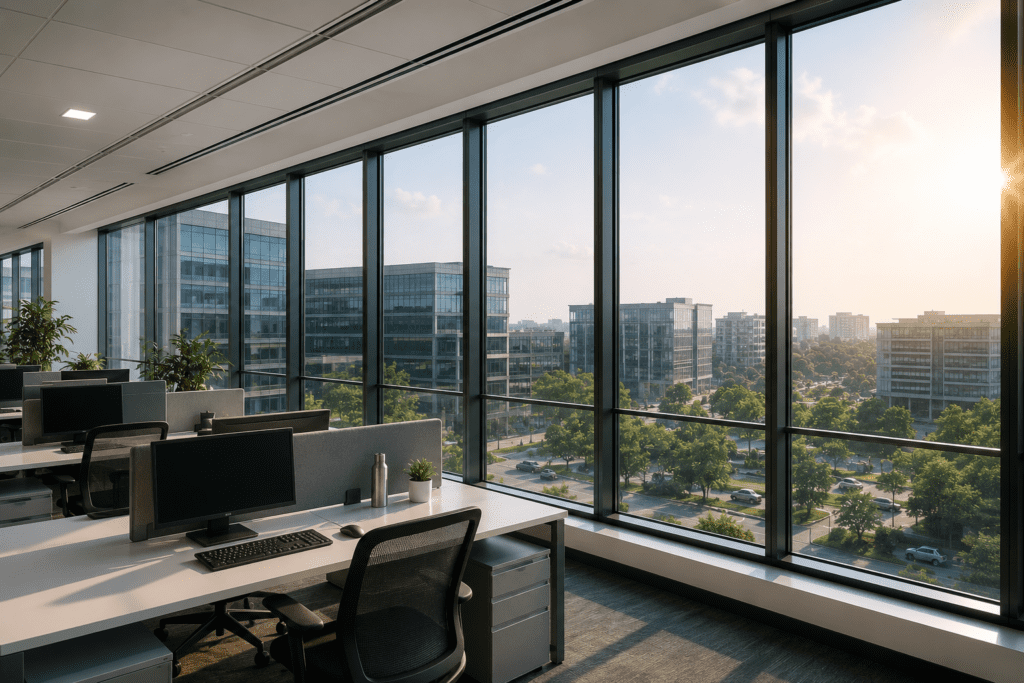
Pune’s IT sector has built one of India’s most significant commercial real estate footprints — from the original Rajiv Gandhi IT Park in Hinjewadi to the newer campuses emerging in Baner, Kharadi, and Magarpatta. These buildings house thousands of employees, run HVAC systems year-round, and consume enormous amounts of electricity in the process.
What most facility managers and building owners in this sector under-appreciate is how much of that energy bill is determined by the windows — specifically, how much solar heat those windows allow in, and how well they hold the cooled interior air in.
This article breaks down the ROI calculation for energy efficient windows in Pune’s commercial office context: what the savings look like, how the payback period is calculated, what the green certification benefits add, and why 2025 is the inflection point for this conversation.
The Baseline Problem: How Much Are Standard Commercial Windows Costing You?
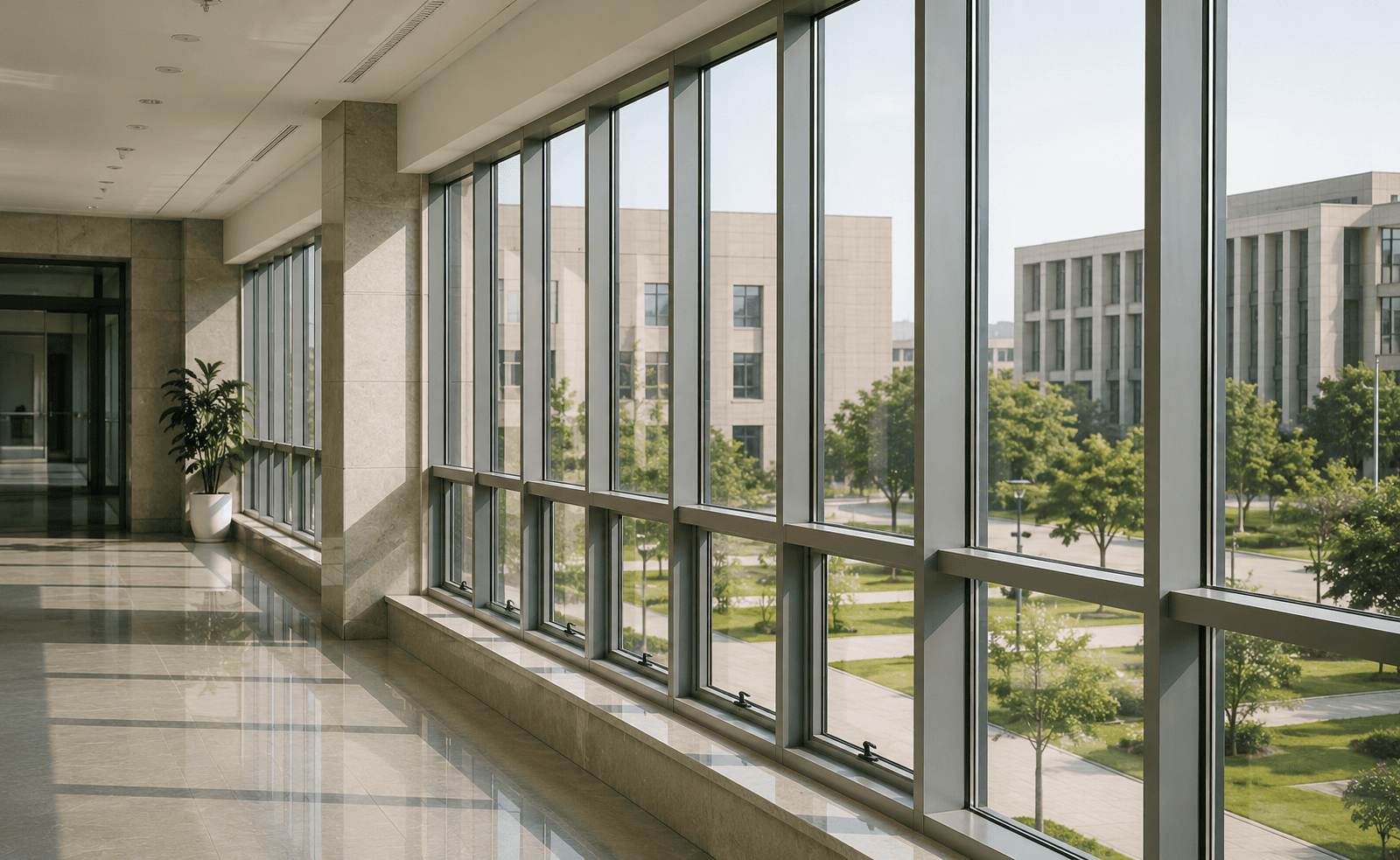
Standard commercial aluminium windows — the type found in most of Pune’s IT park buildings constructed before 2020 — allow significant solar heat gain through the glass and conduct heat through the frame.
In a typical Pune IT office — a 4-storey building in Hinjewadi, floor plates of 20,000 sq ft, running 8–10 hours of AC per day for 11 months of the year — windows account for a disproportionate share of the HVAC load. Here’s why:
Glass is transparent to solar radiation. On a west-facing Pune office facade in May, the glass surface temperature can reach 55–60°C. The heat radiating off that surface into the occupied space forces the HVAC system to work significantly harder than the thermostat setting alone would require. Buildings with large west-facing glazing — common in Hinjewadi and Kharadi campuses built for maximum view and natural light — experience pronounced afternoon cooling loads that push HVAC systems to peak consumption exactly when Maharashtra’s electricity grid is most stressed and tariffs are at their highest.
Standard aluminium frames compound this. Unlike uPVC or thermally broken aluminium, standard aluminium is a near-perfect conductor of heat. The frame continuously transfers outdoor heat into the conditioned space — a secondary but measurable contribution to HVAC load, particularly in buildings with high window-to-wall ratios.
The ROI Calculation: What Energy Efficient Windows Save in a Pune Office
Energy efficient window systems — thermally broken aluminium frames with Low-E double-glazed units — reduce solar heat gain through the glass and eliminate frame-conducted heat. The combined impact on HVAC consumption is measurable and consistent.
Here is a conservative breakdown for a mid-size IT office building in Pune:
Building profile:
- 4 floors, ~20,000 sq ft per floor (80,000 sq ft total)
- 30% window-to-wall ratio (typical for IT park campuses)
- Mixed orientation with significant west and south exposure
- Running 2-pipe FCU HVAC system, 11 months per year, 10 hours/day
Estimated energy impact of window upgrade:
- Low-E double glazing reduces solar heat gain coefficient (SHGC) from ~0.70 (standard clear glass) to ~0.30 — a reduction of over 55% in solar heat entering the building through glass
- Thermal break frames eliminate frame-conducted heat, reducing perimeter load
- Combined HVAC load reduction: conservatively 15–20% of total cooling load attributable to the window upgrade
- At a Pune commercial electricity tariff of approximately ₹8–10 per unit and a baseline HVAC consumption of 400,000 units per year: annual savings of ₹5–8 lakhs per building at the conservative end of the range
Payback period: For a building of this scale, a full window replacement with thermally broken Low-E glazed units from Thermaline® — professionally installed with correct perimeter sealing — represents a capital cost that is typically recovered in energy savings within 5–8 years. For buildings where the windows were due for replacement anyway (15+ years old, failing seals, hardware issues), the incremental cost of upgrading to high-performance specification is recovered faster.
Important note: These figures are indicative. Actual savings depend on building orientation, existing HVAC efficiency, occupancy patterns, and tariff structure. Thermaline® recommends a building-specific energy analysis before committing to a specification.
The Green Certification Multiplier
Beyond direct energy savings, energy efficient windows deliver a certification and asset value benefit that increasingly shows up in commercial property valuations in Pune.
India’s GRIHA (Green Rating for Integrated Habitat Assessment) and IGBC Green Building certification systems both score window thermal performance as a criterion. Buildings seeking or renewing GRIHA certification — which is becoming a requirement for government-leased space and increasingly a preference in IT sector tenancy negotiations — benefit directly from improved window U-values and SHGC ratings.
The financial value of this benefit comes through in two ways:
Rental premium. Green-certified buildings in Pune’s IT corridor command 8–12% higher rental rates per sq ft compared to equivalent non-certified buildings, according to commercial real estate market data. For a building generating ₹2 crore per year in rental income, this premium represents ₹16–24 lakhs in additional annual revenue.
Tenant retention and leasing speed. Major IT sector tenants — particularly multinational companies with ESG commitments — actively prefer green-certified space. Buildings that can demonstrate improved energy performance credentials lease faster and retain tenants longer, reducing vacancy costs.
The 2025 Inflection Point for Pune’s Commercial Market
Three converging factors are making 2025 the year Pune’s commercial building owners are acting on window upgrades rather than deferring them:
Rising electricity tariffs. Maharashtra’s commercial power tariffs have increased meaningfully over the past 3 years and are expected to continue rising. Every percentage point of HVAC load reduction becomes more valuable as the tariff baseline climbs.
Green building mandates in government and IT sector leasing. Several major IT sector tenants have issued 2025–2030 carbon reduction commitments that include building energy performance standards. Landlords whose buildings cannot meet these standards face tenancy risk at renewal.
Building age profile. A significant portion of Pune’s Hinjewadi, Kharadi, and Magarpatta IT park building stock was constructed between 2005 and 2015. Windows in these buildings are now 10–20 years old — approaching or past the point where seal replacement and hardware maintenance are no longer cost-effective alternatives to full replacement.
What to Specify for Maximum ROI in a Pune IT Office
For commercial window replacement in Pune’s IT park context, the specification that maximises the ROI calculation:
Glass: Low-E double-glazed units with SHGC below 0.30 for west and south-facing facades. Argon-filled cavity for improved U-value. Clear or lightly tinted Low-E for north-facing facades where daylighting matters more than solar control.
Frame: Thermally broken aluminium — the structural strength of aluminium with the frame insulation performance needed to eliminate thermal bridging at the frame perimeter.
Curtain wall vs. window replacement: For buildings with curtain wall facades, the calculation differs from buildings with punched window openings. Thermaline® provides commercial-grade thermally broken curtain wall systems alongside individual window replacement options — the right solution depends on the building’s facade type.
Installation quality: In commercial buildings, installation quality and the perimeter seal specification determine whether the performance values of the glass and frame are actually realised in practice. Specifying premium glass in a poorly installed frame produces disappointing results. Thermaline®’s commercial installation team is trained specifically for the tolerances required in commercial thermally broken window systems.
Why Thermaline® for Pune Commercial Projects
Thermaline® has over 20 years of experience delivering thermally broken aluminium window systems for Indian commercial and residential projects. Our commercial team works with building owners, facility managers, and architects on the full specification-to-installation process — including energy analysis support for GRIHA/IGBC certification submissions.
For Pune IT park buildings evaluating window replacement as part of an energy efficiency or certification project, we provide building-specific assessments that include indicative energy savings modelling, payback period calculation, and glass specification recommendations by facade orientation.
If your Pune office building’s windows are more than 10 years old — or if your HVAC bills are climbing without a clear reason — a window assessment is the first step.
