




On December 30, 2025, Delhi woke up to what has become a winter routine: AQI at 444, categorised as Hazardous, visibility below 50 metres, PM2.5 levels at 394 µg/m³ — nearly eighty times the WHO safe guideline. A week earlier, stations at Anand Vihar recorded 644 and Wazirpur 635 as GRAP Stage 4 emergency measures were triggered across the NCR. Dense fog blanketed Gurugram, Noida, and Central Delhi through the morning hours.
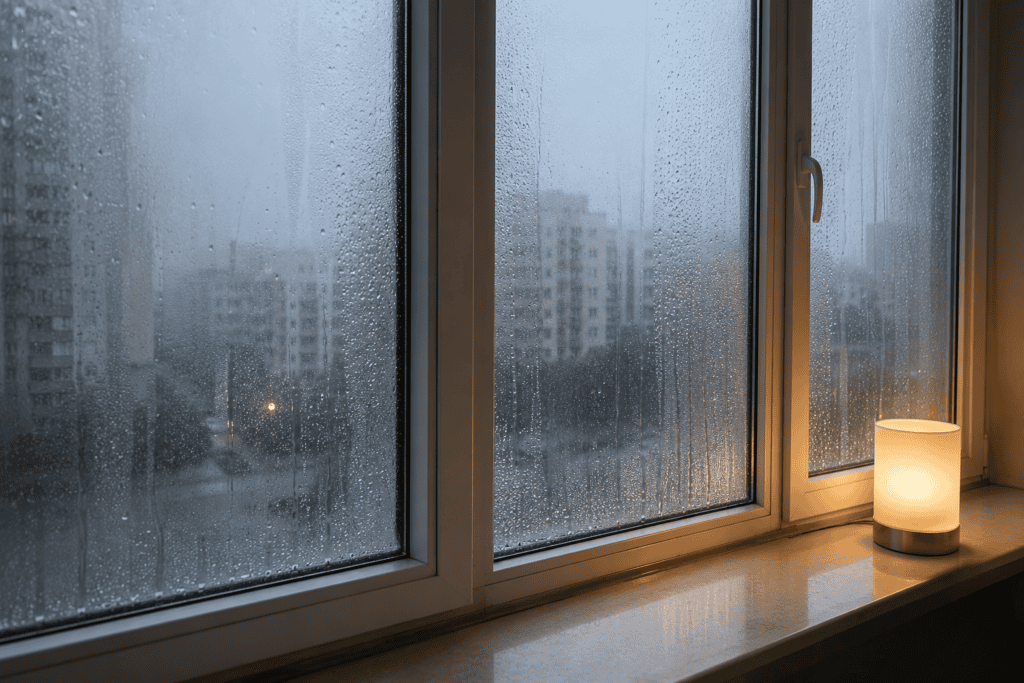
Inside those apartments, something else was happening that residents noticed but often didn’t connect to the wider picture: windows were sweating. The glass covered in droplets. The frame edges damp to the touch. And in apartments that had been dealing with this for several winters, a familiar dark discolouration starting to appear at the frame corners — mould, the slow consequence of the condensation nobody fixed.
Understanding why this happens — and what actually solves it permanently, not temporarily — is the subject of this guide.
Why Delhi Windows Sweat in Winter: The Physical Explanation
Window condensation in Delhi’s winter forms when warm, humid indoor air contacts a cold surface — specifically, the inner face of the glass or frame — and the moisture in that air drops out as liquid water.
The physics is the same as a cold glass of water sweating in a warm room. When warm air contacts a surface cooler than its dew point, the air can no longer hold all its moisture in vapour form, and it releases as condensation. The colder the surface, the more readily this happens.
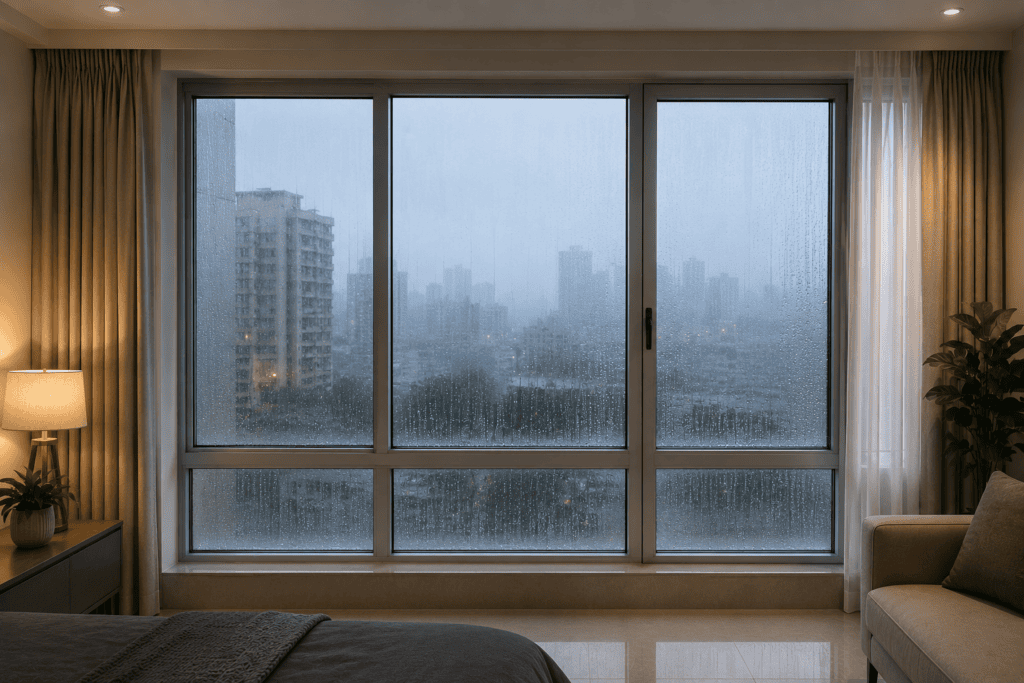
In Delhi’s winter — where outdoor temperatures drop to 6–9°C on cold mornings, with isolated dips below 4°C during cold wave periods — the inner face of a standard single-pane window or a standard aluminium frame can drop to temperatures where condensation forms even at normal indoor humidity levels. The frame is the worse offender: standard aluminium conducts the outdoor cold directly to its inner face, making the frame surface often colder than the glass centre — which is why condensation typically appears at frame edges first, particularly at corners where structural stress concentrations create the best conditions for moisture to accumulate.
Why Delhi’s Winter Condensation Is Different From Other Cities
Two factors make Delhi’s condensation problem worse than most Indian cities experience, even at similar temperature levels.
The indoor heating factor. Delhi’s winter genuinely requires heating — room heaters, geysers, electric blankets. Heating raises indoor temperature, which allows indoor air to carry more moisture before reaching saturation. When this warmer, more moisture-laden indoor air then contacts the cold window surface, the temperature differential is larger and condensation forms more readily and more visibly.
The air quality sealed-room factor. Delhi’s winter PM2.5 crisis — documented at peak average levels of 91.5 µg/m³ in 2025 with individual readings above 600 — means residents keep windows and doors sealed for weeks at a time during November through February. This sealed environment means indoor humidity from cooking, breathing, and bathing has nowhere to go. It builds up progressively, raising the indoor dew point and making condensation on cold window surfaces increasingly likely.
This is the mechanism most residents and even many window suppliers miss: the worse Delhi’s air quality gets, the more sealed the indoor environment becomes, and the more severe the condensation problem grows — irrespective of the number of days the temperature actually dips.
What Doesn’t Solve Condensation (and Why People Try It Anyway)
Before reaching the permanent solution, it’s worth being direct about the approaches that don’t work:
Wiping the condensation daily. This addresses the water on the surface, not the cold surface that causes it. The condensation returns the next morning.
Ventilation and dehumidifiers. Ventilation would help — but opening windows during a Delhi winter AQI event above 300 is a direct health risk. Dehumidifiers reduce indoor moisture, which does help, but they’re running continuously and consuming electricity to compensate for a problem that can be addressed at the source.
Putting insulation film on glass. This reduces conduction through the glass somewhat but does nothing about the frame, which is often the colder surface. The film also degrades and needs replacement.
Sealing the window more tightly. If the condensation is on the indoor glass or frame surface, additional sealing doesn’t help — the cold is conducted through the frame material itself, not through gaps.
The Permanent Solution: Why Thermal Break Frames Eliminate Condensation
Condensation forms when the indoor-facing surface of the window — glass or frame — drops below the dew point of the indoor air. The permanent solution is raising the temperature of that indoor-facing surface so it stays above the dew point. Thermal break frames do this by preventing the outdoor cold from conducting to the interior.
A standard aluminium frame is one continuous piece of metal. When the outdoor face drops to 4°C on a Delhi January morning, the cold conducts through the frame and the indoor face can reach 6–8°C — well below the dew point of a normal indoor environment. Condensation is inevitable.
A thermally broken frame splits the aluminium into outer and inner sections, joined by a reinforced polyamide strip. The polyamide’s thermal conductivity is approximately 700 times lower than aluminium’s. The indoor frame face stays close to indoor air temperature regardless of what the outdoor face experiences. At 4°C outside with 22°C inside, the inner frame face remains in the range of 18–20°C — comfortably above the dew point. Condensation simply doesn’t form.
The glass needs to match this performance. Single-pane glass conducts cold similarly to an unbroken aluminium frame. Double-glazed units — with an air or argon-filled gap between two glass panes — significantly raise the temperature of the inner pane surface, reducing or eliminating glass-face condensation. The combination of thermal break frame and double-glazed unit is the system that permanently resolves Delhi’s winter condensation problem.
The PM2.5 Connection: Condensation Creates the Infiltration Pathway
There’s an indirect connection between Delhi’s condensation problem and its air quality problem that deserves specific mention, because it’s one most window suppliers don’t discuss.
Condensation at frame corners means that moisture is regularly present at the most structurally stressed points of the window frame. Over years of repeated winter condensation cycles, this moisture softens sealants, penetrates micro-cracks in the frame coating, and degrades the perimeter seal between the frame and the wall. Once degraded, these gaps become infiltration pathways for PM2.5 — the very particles Delhi residents are trying to keep out by keeping their windows sealed.
Standard aluminium frames with condensation problems are, over time, actively creating the air quality vulnerability they were supposed to prevent. Thermal break frames that eliminate condensation also eliminate the moisture damage mechanism that degrades perimeter seals — directly improving the window’s long-term performance against PM2.5 infiltration.
Competitor Reality Check: Who Is Actually Solving This for Delhi
The Delhi NCR window market includes ALCOI, now positioning itself aggressively as India’s top aluminium window brand through press releases claiming “Best Company 2026-27” — content built primarily for brand awareness rather than technical guidance. Their published content doesn’t address the condensation-PM2.5 infiltration connection described above.
AluPure — now transitioned to Koemmerling Aluminium Systems as of December 2025 — brings genuine German engineering heritage. The Koemmerling brand internationally does address condensation in its product documentation, but India-specific technical content for Delhi’s particular combination of winter cold, sealed-room AQI crisis, and heating-driven humidity accumulation isn’t prominent in their published materials.
Prominance focuses on uPVC, which does have inherent condensation resistance advantages over standard aluminium (uPVC conducts heat less readily, so frame surface temperatures stay higher). But for large-format openings or commercial applications, uPVC’s structural limitations apply as previously discussed.
Thermaline®’s EcoCasement® and EcoSlide® systems, with thermal break frames and double-glazed unit specifications, eliminate Delhi winter condensation at the source — by keeping the inner frame surface warm. Our 20+ years of Indian climate engineering includes specific knowledge of how Delhi’s winter cold combines with sealed-room indoor humidity to create the condensation conditions most suppliers treat as inevitable. They are not inevitable. They are a specification problem with a specification solution.
If your Delhi NCR apartment has visible condensation on window frames or glass during winter, speak to Thermaline® before next November. The fix is a one-time decision, not an annual management exercise.
FAQs
Why does window condensation occur in Delhi winters?
Window condensation occurs when warm, humid indoor air contacts a cold indoor-facing surface of the window, causing moisture to drop out as liquid water. In Delhi, the inner frame can become very cold because standard aluminium conducts outdoor cold to the interior, making condensation appear first at frame edges and corners where stress concentrates moisture.
Why is Delhi’s condensation worse than in other cities?
The problem is amplified by indoor heating, which raises indoor temperatures and allows more moisture in the air, and by a sealed-room environment during severe winter air pollution, which traps humidity from cooking, breathing, and bathing indoors, increasing the indoor dew point and condensation. This combination makes condensation form more readily even at similar outdoor temperatures.
What approaches to condensation are not effective?
Wiping the condensation daily addresses only the surface water and not the cold surface; ventilation and dehumidifiers can help but opening windows during high AQI is risky and running dehumidifiers wastes electricity; insulation film on glass helps little because the frame remains cold and the film degrades; sealing the window more tightly does not reduce condensation when it is on the indoor glass or frame surface.
What is the permanent solution to Delhi’s condensation problem?
The permanent solution is to raise the temperature of the indoor-facing surface above the indoor dew point. This is achieved with thermally broken frames that prevent outdoor cold from conducting to the interior, keeping the inner frame face warm, and with double-glazed units that raise the inner pane surface temperature, together eliminating condensation.
How does condensation connect to PM2.5 infiltration and indoor air quality?
Condensation at frame corners keeps moisture at structurally stressed points, gradually degrading perimeter seals and creating infiltration pathways for PM2.5. Thermal break frames that eliminate condensation also protect seals, reducing long-term PM2.5 infiltration through window gaps.
