
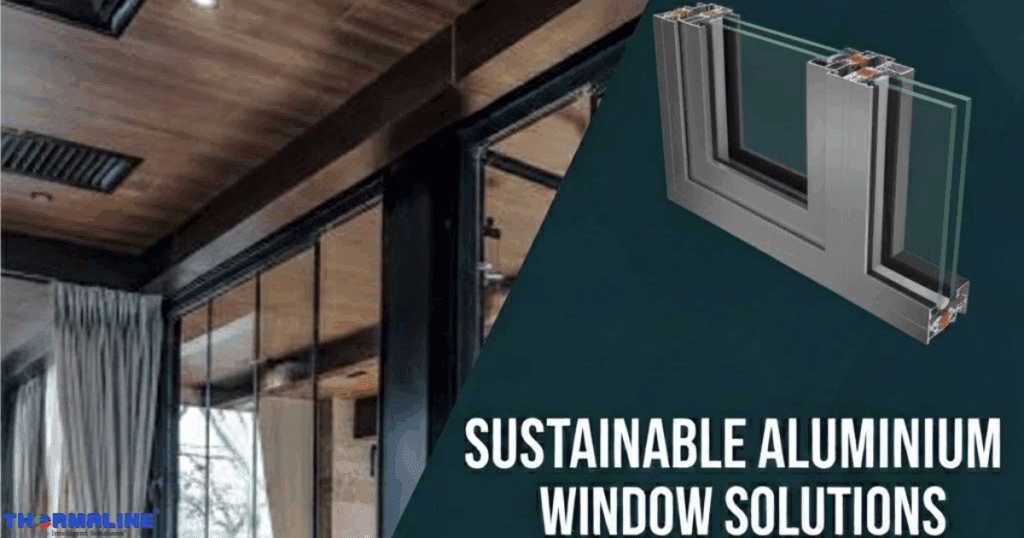
The Green Dilemma: Why the Smartest Sustainable Choice for Windows Is Misunderstood
Let’s be honest about the word “sustainable.” In our industry, it’s often misused, overpromised, and rarely tied back to the one thing every client truly cares about: long-term performance and financial sense.
Sustainability isn’t just about initial materials; it’s about a product’s entire working life. When you invest in a home in India, you are making a 40-year commitment. You need materials that perform for four decades without degrading, demanding replacement, or secretly bankrupting you via the utility bill.And this is where the popular narrative about windows often falls apart. The truth is, the most financially and environmentally responsible choice for modern construction is Engineered Aluminium.
Why? Because the conversation that focuses solely on aluminium’s energy-intensive initial production misses its two monumental advantages: its near-perfect recyclability and its unmatched, decades-long energy efficiency.
At Thermaline, we are engineers. We deal in performance metrics, not greenwash. Let’s break down the investment philosophy behind true Sustainable Aluminium Window Solutions.
The Great Misconception: Lifecycle vs. Launch Cost
The initial energy needed to refine primary aluminium is high. That is a fact. But focusing only on that is like judging a marathon runner solely on their starting sprint.
Aluminium’s Infinite Life: The True Circular Economy
This is the material’s superpower, and its greatest contribution to the planet. Aluminium is 100% and endlessly recyclable with no drop in quality.
- The Investment Insight: When your high-performance window reaches the end of its useful life (often 30-40 years down the line), it doesn’t become landfill waste. It becomes high-value feedstock. Recycling that metal requires less than 5% of the energy needed for its original creation.
- The Interpretation: By choosing aluminium, you are making a commitment to the circular economy. You are borrowing the material, ensuring its energy profile is amortized across decades and dozens of future uses. No other common window material offers this level of resource preservation.
Durability is Sustainability: A 40-Year Promise
A material that fails in 15 years, forcing replacement, is inherently unsustainable, regardless of its original cost.
- The Stability Factor: Aluminium’s structural stability resists the kind of warping and degradation that plagues other materials in India’s harsh sun and intense moisture cycles. It is impervious to common threats like termites and rot.
- The Builder’s View: Less replacement means less waste, fewer transport costs, and less consumption of new resources. Longevity is the quiet cornerstone of environmental responsibility.
If you are interested to know the parameters of choosing the perfect window frame according to your need, read here.
The Daily Battle: Energy Efficiency that Pays the Bills
The biggest drain on resources isn’t the building materials; it’s the building’s operation. If your window leaks energy, it’s actively contributing to climate change and actively emptying your bank account every month.
The Thermal Break Advantage: Active Carbon Reduction
This is the core of our engineering philosophy. We know the Achilles’ heel of metal is its conductivity.
- The Fix: A thermally broken aluminium system physically separates the inner frame from the outer frame with a sophisticated insulator. This stops the heat (or cold) transfer dead.
- The Impact: When you eliminate thermal bridging, your air conditioning system is no longer fighting a losing battle against the window frames. The resulting reduction in operational electricity consumption—sustained over four decades—is the largest, most effective environmental contribution your window can make. It’s the highest return on investment in sustainability you can buy.
Glazing That Works: Solar Control and AI
Sustainable aluminium provides the rigid framework necessary to house the heavy, complex glass systems required for modern efficiency standards:
- Solar Control: We can specify coatings (like Low-E) that reflect solar heat without sacrificing natural light. This active management of solar gain is non-negotiable for low-energy buildings in India.
- Green Certification: Achieving high ratings with bodies like GRIHA or IGBC depends almost entirely on the tested performance metrics of the window system (U-value, SHGC). Sustainable aluminium systems provide the verifiable data required to meet these rigorous standards.
The Thermaline Verdict: Engineering for Principle
We believe that building responsibly is simply better engineering.
The choice of sustainable aluminium window solutions is not an expensive luxury; it’s a sound, future-proof investment that respects your finances and the environment equally. You shouldn’t have to choose between a clear conscience and a comfortable home.
Demand high performance. Demand longevity. Demand the engineering that makes your home an active solution, not a passive problem.
FAQs
Why is engineered aluminium considered the most sustainable choice for windows in the long term?
Engineered aluminium is regarded as the most sustainable choice because it is 100% recyclable without quality loss and offers decades-long energy efficiency, making it a highly resource-preserving and environmentally responsible option.
How does the initial energy investment in aluminium compare to its lifecycle benefits?
Although the initial energy needed to refine primary aluminium is high, its ability to be infinitely recycled and reused significantly reduces its environmental impact over its lifespan, aligning with a true circular economy.
What makes aluminium durable and environmentally sustainable over 40 years?
Aluminium’s structural stability resists warping, degradation, and threats like termites and rot, meaning it requires less replacement, reduces waste, and ensures long-term environmental sustainability.
How does thermal break technology improve energy efficiency in aluminium windows?
Thermal break technology involves physically separating the inner and outer frames with insulation, which stops heat transfer and reduces operational energy consumption, making your windows highly energy-efficient over decades.
In what ways do sustainable aluminium windows contribute to green building certifications?
Sustainable aluminium windows provide verifiable data on performance metrics such as U-value and SHGC, essential for achieving high ratings in standards like GRIHA or IGBC, thus supporting green building certifications.
