

Every Mumbai homeowner researching windows eventually lands on the same fork in the road: thermal break aluminium or uPVC. Both materials have genuine advocates in the Indian market, both perform reasonably well in general terms, and both are actively marketed in Mumbai with claims that — taken individually — sound convincing.
What’s missing from most of this content is an honest answer to the specific question Mumbai homeowners are actually asking: given Mumbai’s particular combination of monsoon intensity, coastal humidity, high-rise wind exposure, and the large-format glass openings that define the city’s premium residential architecture, which material genuinely performs better — and where does each one actually fall short?
This is that comparison, without a predetermined conclusion.
Thermal Performance: Where the Two Materials Actually Differ
Thermally broken aluminium uses a reinforced polyamide strip to separate the outer and inner sections of an otherwise highly conductive aluminium frame. This interrupts the thermal bridge that would otherwise let heat (or cold) pass directly through the metal. The resulting frame U-value typically ranges from 1.6–2.2 W/m²K depending on the specific system.
uPVC is inherently a poor conductor of heat — the material itself doesn’t need a thermal break because PVC’s thermal conductivity is naturally low (roughly 0.16-0.20 W/m·K, similar to the polyamide strip used in thermal break aluminium). Standard multi-chamber uPVC profiles achieve frame U-values in a comparable range to thermal break aluminium, sometimes slightly better.
Honest verdict on thermal performance: For Mumbai’s relatively mild temperature range (compared to Delhi or Ahmedabad), the difference between properly specified thermal break aluminium and quality uPVC is genuinely marginal. Both materials, when combined with appropriate Low-E glass, deliver comparable AC energy savings. This is one area where marketing tends to exaggerate the gap — for Mumbai specifically, thermal performance alone is not the deciding factor.
Monsoon and Water Resistance: A More Meaningful Difference
This is where Mumbai’s specific climate creates genuine performance separation between the two materials — though not in the direction most marketing suggests.
uPVC’s material advantage: uPVC doesn’t corrode. This is a real, structural benefit in Mumbai’s combination of monsoon humidity and, for coastal properties, salt air exposure. A uPVC frame exposed to years of monsoon moisture won’t develop the galvanic corrosion that can affect poorly specified aluminium hardware and fasteners.
uPVC’s structural limitation: uPVC’s dimensional stability decreases significantly at larger panel sizes and under sustained thermal cycling. Mumbai’s premium residential architecture increasingly specifies large-format sliding doors and windows — 2.5 to 3+ metre spans for living room openings facing the sea or city views. At these dimensions, uPVC profiles require additional internal reinforcement (typically galvanised steel inserts) to maintain rigidity, which adds cost and complexity, and even reinforced uPVC has practical span limitations that thermally broken aluminium doesn’t share.
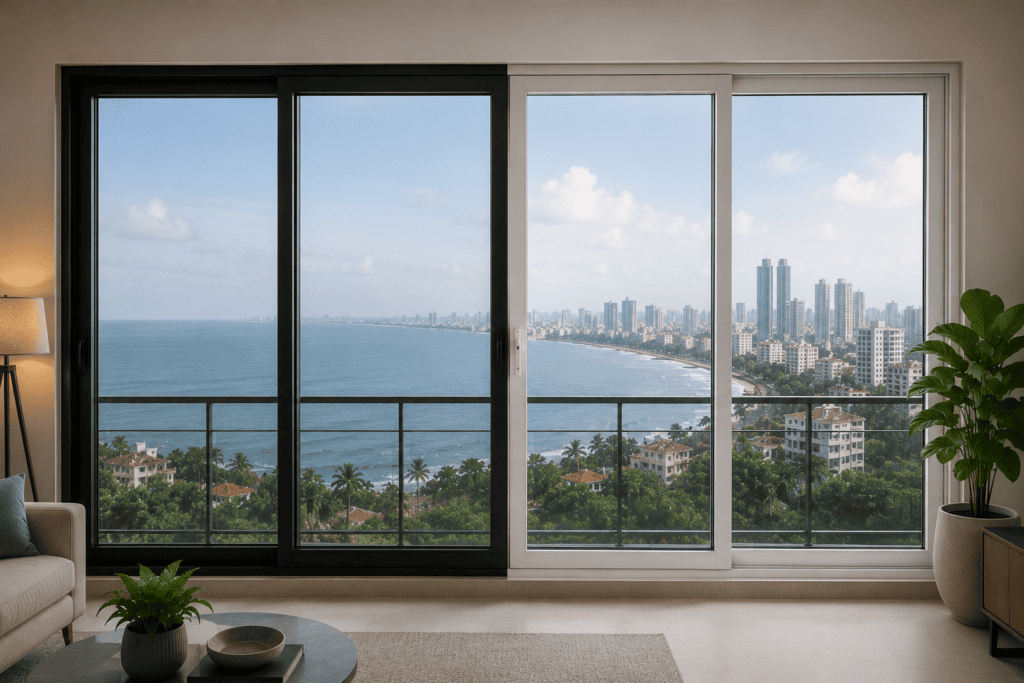
Thermal break aluminium’s structural advantage: Aluminium’s inherent strength-to-weight ratio allows thermally broken frames to span larger openings with slimmer sightlines while maintaining the rigidity needed to resist wind load — a meaningful consideration for Mumbai’s high-rise towers above the 15th floor, where wind pressure during monsoon storms is substantial. The frame doesn’t flex under load the way an unreinforced or under-specified uPVC frame might at the same span.
Thermal break aluminium’s corrosion consideration: Aluminium itself, when properly anodised or PVDF-coated, resists corrosion well even in coastal conditions. The risk in aluminium systems comes specifically from hardware (hinges, locks, fasteners) if specified with standard zinc-alloy components rather than stainless steel — a specification detail, not an inherent material flaw.
Honest verdict on monsoon performance: For smaller, standard-size windows in non-coastal Mumbai locations, uPVC’s corrosion immunity is a genuine practical advantage with few drawbacks. For large-format openings, high-rise applications above the 15th floor, or coastal-facing properties along Worli, Bandra West, or Marine Drive where wind load and structural span matter more than corrosion risk alone (which is manageable with proper aluminium specification), thermally broken aluminium with marine-grade hardware is the stronger choice.
Large-Format Openings: Where the Comparison Becomes Less Close
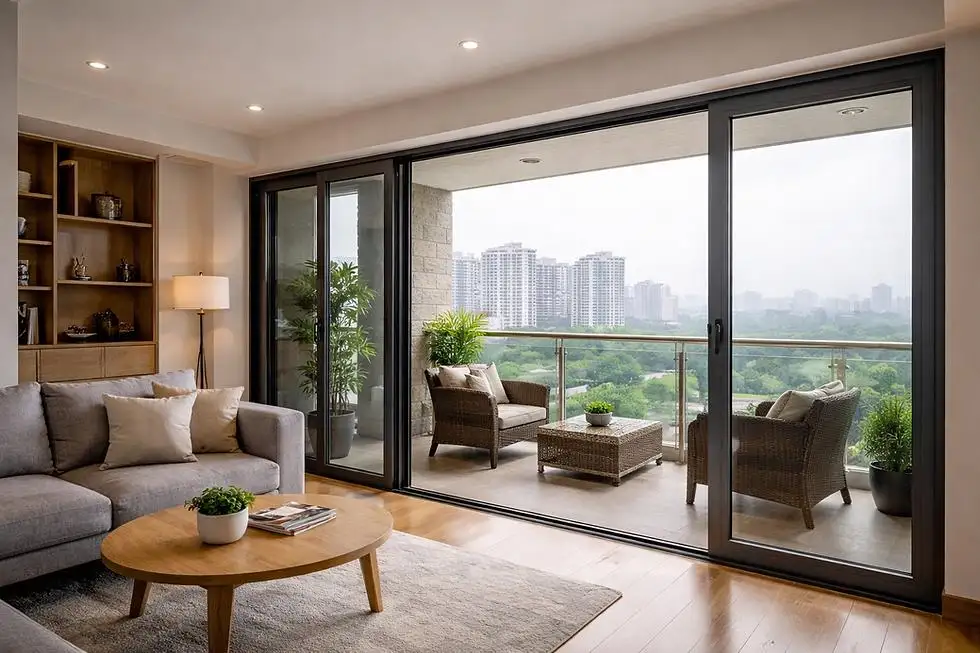
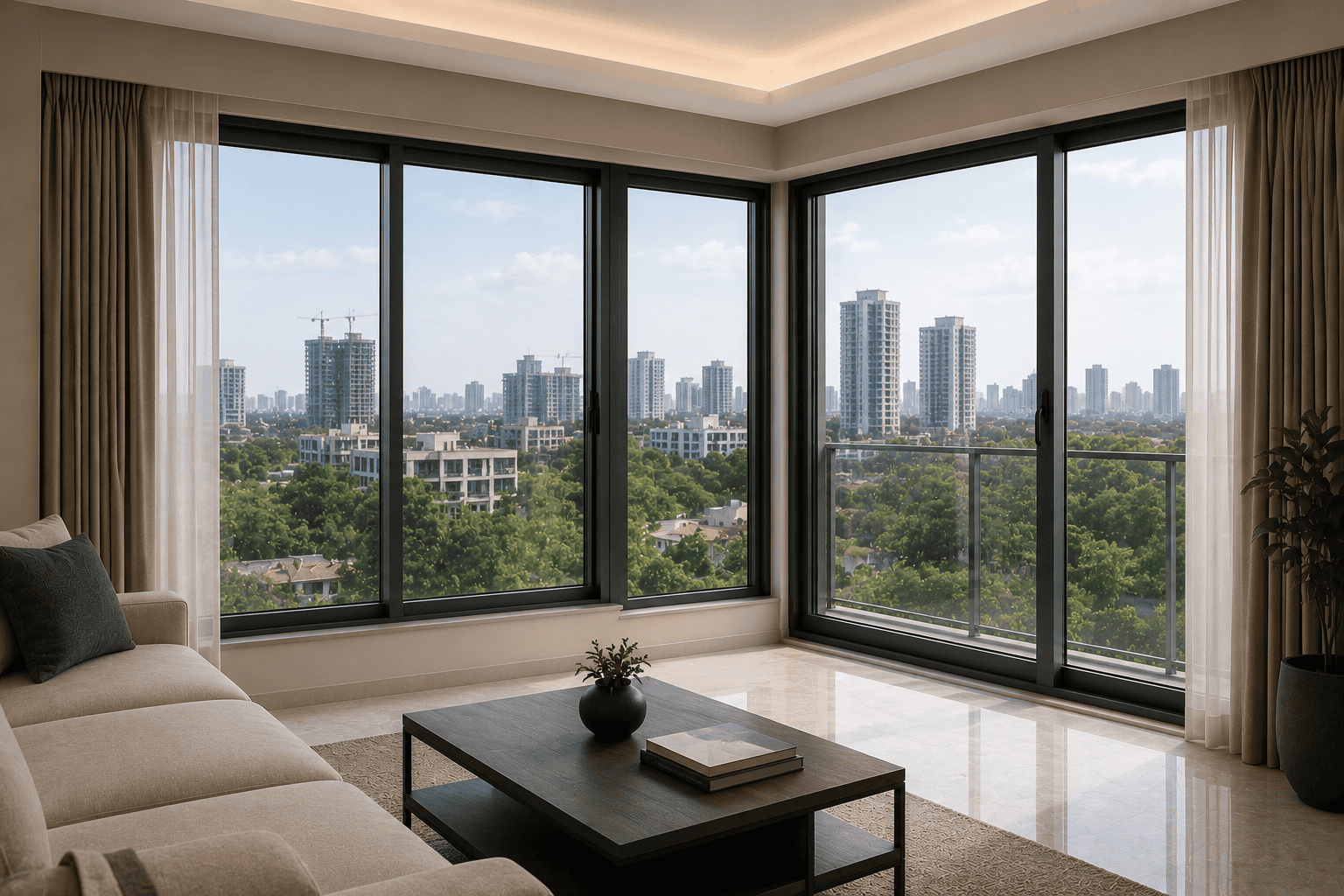
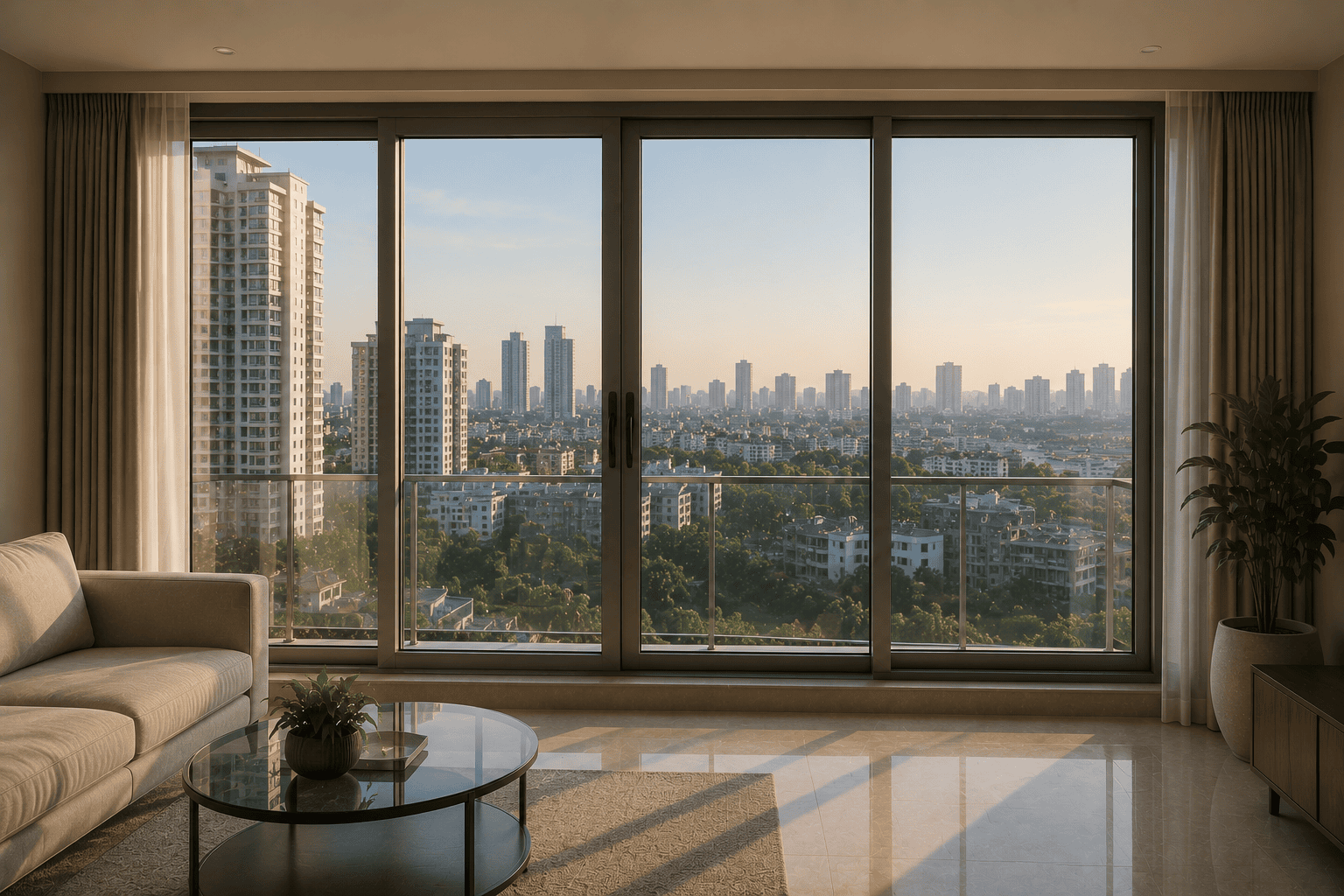
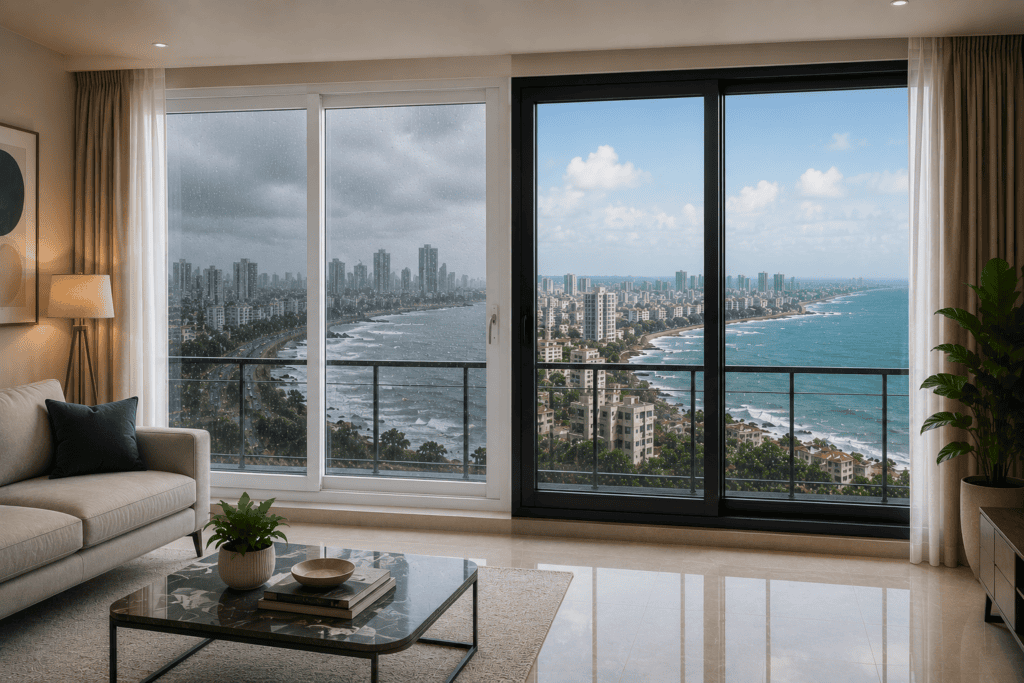
Mumbai’s premium apartment and villa market has moved decisively toward large glass openings — floor-to-ceiling living room walls, wide sliding doors onto balconies, panoramic sea-facing windows. This is where the material comparison stops being close.
uPVC’s maximum practical span for a single sliding panel, even with steel reinforcement, generally tops out in a range that constrains design options for Mumbai’s most ambitious architectural briefs. Beyond this range, uPVC requires either additional mullions (breaking up the glass into smaller panels, which compromises the minimal aesthetic) or accepting performance compromises in wind load resistance and long-term dimensional stability.
Thermally broken aluminium, including systems like Thermaline®’s EcoSlide®, is engineered specifically for wide-format applications — spans of 3+ metres per panel are achievable while maintaining structural rigidity and slim sightlines. For Mumbai’s premium segment, where the architectural ambition increasingly includes uninterrupted views, this is a genuine and significant differentiator in aluminium’s favour.
Cost: The Comparison Most Marketing Gets Backwards
Conventional wisdom suggests uPVC is the budget option and aluminium the premium one. In Mumbai’s actual market, this isn’t always accurate.
Standard, smaller-format uPVC windows are generally less expensive than thermally broken aluminium at equivalent quality tiers. But once you require reinforcement for larger panels, premium hardware, or acoustic glass upgrades — all common requirements in Mumbai’s mid-to-premium residential segment — the cost gap narrows substantially, and in some large-format configurations, reinforced uPVC can cost comparably to or more than properly specified thermal break aluminium, while delivering inferior span and aesthetic performance.
Honest verdict on cost: For small, standard windows in budget projects, uPVC typically remains the lower-cost option. For Mumbai’s premium segment with large openings, acoustic requirements, and high-rise wind load considerations, the cost difference between quality thermal break aluminium and adequately specified uPVC is often smaller than buyers expect — making the performance differences described above the more relevant decision factor.
Longevity: The 20-Year Question
Both materials, properly specified and maintained, can deliver 20+ years of service life in Mumbai’s climate. The failure modes differ:
uPVC’s long-term risk: UV degradation over decades can cause brittleness and discolouration, particularly in west-facing, sun-exposed installations. Mumbai’s intense year-round sun accelerates this more than in cooler climates. Quality uPVC with UV stabilisers performs significantly better than budget alternatives, but the material’s UV resistance ceiling is lower than properly coated aluminium’s.
Thermal break aluminium’s long-term risk: Coating quality determines longevity. PVDF-coated aluminium maintains its finish for 20-25+ years even in coastal exposure; standard polyester powder coating shows fading and chalking within 8-12 years in Mumbai’s intense sun and salt air combination. The aluminium structure itself doesn’t degrade, but an underspecified coating will visibly age faster than the frame underneath.
So Which Should You Choose for Your Mumbai Home?
Choose uPVC if: Your windows are standard residential sizes, you’re working within a defined budget, your property is non-coastal or moderate coastal exposure, and your architectural brief doesn’t require large unbroken glass spans.
Choose thermally broken aluminium if: You’re specifying large-format openings (2.5m+ spans), your property is in a high-rise above 15 floors or in a directly coastal location (Worli, Bandra West, Marine Drive), your project has an architectural brief favouring minimal sightlines and panoramic glass, or you need acoustic laminated glass options that integrate more readily with aluminium’s structural depth.
Where Thermaline® Fits in This Comparison
This comparison has been deliberately balanced — uPVC genuinely outperforms aluminium in specific scenarios, and pretending otherwise would be dishonest marketing, not useful guidance.
What Thermaline® brings to the thermal break aluminium side of this comparison is 20+ years of engineering specifically for Indian conditions, including Mumbai’s monsoon intensity and coastal exposure — not an adapted European product line. Our EcoSlide® and EcoCasement® systems are specified with PVDF coating options for coastal durability, marine-grade hardware, and structural profiles engineered for the large-format openings that define Mumbai’s premium residential architecture.
The Mumbai market also includes AluPure — which transitioned to the Koemmerling Aluminium Systems brand in December 2025 as part of a broader profine Group repositioning — and Prominance, a well-established uPVC specialist with significant Mumbai dealer presence. Both are legitimate options within their respective material categories; the right choice depends on your specific project brief, not brand loyalty.
If you’re weighing this decision for a Mumbai home or project, speak to Thermaline® for an honest assessment of which material and specification genuinely fits your opening sizes, floor level, and exposure — not a sales pitch toward whichever product we happen to be discussing.
FAQs
Which material performs better thermally in Mumbai, thermal break aluminium or uPVC?
In Mumbai’s mild temperature range, properly specified thermal break aluminium and quality uPVC offer comparable thermal performance when used with appropriate low-emissivity glass; the difference is marginal and typically not the deciding factor for energy savings.
How do monsoon and coastal conditions affect the two materials?
uPVC resists corrosion and thus has a clear advantage in humid, salt-laden coastal climates. However, for large or high-rise openings and coastal locations, aluminium with marine-grade hardware provides stronger durability against wind loads, while corrosion is more a hardware issue in aluminium than a material fault.
What should I know about large-format openings and their impact on material choice?
For large-format openings, aluminium is generally preferred as it can span 2.5 to 3+ metre panels with slim sightlines and high rigidity, whereas uPVC requires internal reinforcement and can face practical span and aesthetic limitations.
Is aluminium always more expensive than uPVC in Mumbai?
Not always. Small standard windows in budget projects may be cheaper with uPVC, but for premium segments requiring large openings, acoustic upgrades, or high wind-load resistance, the cost gap narrows and can be similar to reinforced or upgraded uPVC options.
What about longevity and coating quality for these materials in Mumbai?
Both can last 20+ years with proper maintenance. uPVC’s UV stability matters over decades, with better performance from UV-stabilised profiles; aluminium’s coating determines longevity, with PVDF coatings lasting 20–25+ years in coastal conditions, while standard polyester finishes may age more quickly.
